Total Fire Group Ltd. News

A fire strategy is a complex document specifically tailored to a building, reviewing all aspects of the building’s fire safety. A fire strategy defines the fire safety objectives and performance requirements for a building and the methods by which these objectives will be provided to ensure the safety of occupants and property protection. Because every building is unique in terms of design, occupancy, and usage, the business needs a unique fire strategy to reduce the risk of a fire and...
A fire risk assessment is an organized and methodical look at the premises, the activities carried out on there and the likelihood that a fire could start and cause harm to those in and around the premises. Fire risk assessments are essential for buildings that fall into the non-residential sector and are a huge component of overall fire safety. This article goes in depth regarding the objectives of a fire risk assessment. Fire risk assessment The aims of a fire risk assessment are to:...
Fire doors play a huge role in fire safety and yet they are the most commonly overlooked aspect of buildings. The Grenfell Tower Inquiry in the Phase 1 report noted that “Fire doors play an essential role in preventing or inhibiting the spread of smoke and toxic gases and in preserving the effective compartmentation of buildings.” And yet, many buildings do not have fire doors that meet the required standard. Fire Safety (England) Regulations Subsequently, as of 23rd January 20...
The most important thing to consider with a new build, whether its purpose is apartments or offices, is safety. Things can go wrong quickly, so preparation and prevention are key. In case of a fire, fire extinguisher installation is crucial for defusing a situation before it becomes an emergency. Especially when many new builds are tower blocks, the risk of being unable to evacuate safely becomes greater. Fire extinguisher regulations The Regulation Reform (fire safety) Order 2005 covers...
Fire doors play a critical role in preventing the spread of fire and smoke within commercial and residential buildings. They are specifically designed and constructed to resist fire for a specific period, providing valuable time for people to evacuate the building safely. However, fire doors are only effective if they are installed correctly and maintained regularly. This article is going to explore the importance of fire door maintenance, why regular inspections are vital for fire door safe...
With hundreds of staff and guests (some who may only be within the property for a short period of time), and dozens of potential fire risks, fire safety is an extremely high priority for hotels. That’s why it’s vital as a hotel owner that one has a comprehensive fire strategy in place. A fire strategy is a complex document specifically tailored to a building, reviewing all aspects of the building’s fire safety. Because every building is unique in terms of design, occupancy a...
Fire safety in care homes is extremely important as these environments involve some of society’s most vulnerable people, some of whom may have health conditions that make things like evacuations much more difficult. That’s why it’s imperative to have the right regulations in place when it comes to fire safety. The risk of fire is present pretty much everywhere, but care homes carry their own unique risks. Government statistics show that there are, on average, 388 UK care home...
The landlord of a block of flats is considered the Responsible Person, who in the event of a fire, has to ensure the safety of all the occupants of the block of flats. And while people may be aware that an up-to-date fire risk assessment is a legal requirement for this type of building, they might not be aware that there are actually four types of fire risk assessments that landlords need to consider. Here are the four types of fire risk assessment and when and why users might need to implem...
Fire safety should be a top priority all year round for commercial business owners, but as they head into winter, it’s important to keep in mind fire safety and the unique challenges businesses can face during this period. The Chief Fire Officers Association (CFOA) estimates that 60% of privately owned businesses never recover from fire and its knock-on effects. With that in mind, Total Fire Group is going to share some fire safety tips for winter that people and their businesses should...
Fire risk management software can revolutionize how users complete fire risk assessments, allocate jobs, priorities, and complete actions. Here are some reasons why fire safety software may well be the best gift people could buy for their business this Christmas. Fire risk management software is a surefire way to streamline communications between users, their assessors, and their clients. Any business owner knows that managing employees in the field can be difficult, but field service software...
Care home fire safety is vital all year round, but winter brings about some specific fire safety concerns that should be addressed. Here are some of the care home fire safety tips for winter. Evacuation plans and routes are an essential part of care home fire prevention, but extra considerations need to be thought about when winter arrives. For example, is snow build-up likely to be a problem for wheelchair users or those using mobility scooters? Are escape routes adequately gritted to preven...
Schools can be unpredictable. With hundreds of people running around the school, it’s impossible to keep on top of what everyone is doing. Consequently, every year, approximately 90,000 pupils in the UK find their education disrupted because of a fire. In comparison to other types of commercial buildings, schools are nearly twice as likely to have a fire. It’s a huge point of concern, and while schools cannot control everything, they can massively decrease the risk of a fire and be...
There are 5 main steps to carrying out a fire risk assessment. First, users need to identify any fire hazards in the workplace. This could include things like electrical sockets, equipment used for cooking or heating, and any combustible materials stored on site. The first step is being aware of them and how they might have the potential to cause a fire. Next, users need to identify if there are people specifically at risk. For example, do users employ any vulnerable or elderly people or thos...
The shift towards remote and hybrid working models is undoubtedly here to stay, and while it’s seen as a positive change for employees, it’s also had a significant impact on the fire safety of commercial office buildings. Even the simplest of buildings will require some form of a fire alarm system, and if a building has a fire alarm installed, whether it is occupied or vacant, the system must be regularly maintained. Just because a building is either vacant or not occupied to cap...
The start of a new year is a great time for businesses to review their fire safety protocols and ensure that they are in compliance with all applicable laws and regulations. By taking the following steps, users can ensure that their facilities are safe for employees and customers, and minimize the risk of fire-related accidents and damage. The first step in ensuring compliance with fire safety regulations is to review a company’s current policies and procedures. Look for areas that may...
New fire safety regulations will come into effect from 23rd January 2023 relating to buildings that contain more than one residence. The duties in these Regulations supplement those imposed by the Regulatory Reform (Fire Safety) Order 2005. These new regulations relate to buildings in England that comprise two or more domestic premises (including the residential parts of mixed-use buildings), including blocks of flats (whether purpose-built or converted from another type of building, such as a...
If anyone thinks that just because the building is empty that fire safety, and in particular fire risk assessments, is no longer a concern, they would be very wrong. Despite the fact that the building is empty, the same legal obligations apply for an empty building as for an occupied one, and that responsibility is with the present owner until another takes over. Every year, many unoccupied properties fall victim to fire damage. While users might think that the risk of fire is significantly les...
Fire compartmentation is defined as: “A building or part of a building comprising one or more rooms, spaces, or stories constructed to prevent the spread of fire to or from another part of the same building or an adjoining building.” This means that certain buildings, particularly those where there is a sleeping risk such as care homes, hotels, and flats, are designed and constructed in such a way as to prevent the spread of fire and smoke from one part of the building to another,...
Health and safety, and in particular, fire safety, are important for retailers all year round. However, the festive season brings with it increased risks and unique challenges that retailers should be aware of as they head into the busy Christmas period. In anticipation of high demand and increased sales, shops will have additional stock levels to cope with the demands of shoppers. However, high stock levels can cause an increased fire risk in a number of ways. Firstly, stock and associated pa...
Fire protection, prevention, and suppression systems are all fundamental parts of fire safety. However, while these systems all work together to create a holistic fire safety plan, it’s important to understand the difference between the three. Fire protection systems are designed to protect a building’s occupants and minimize the damage associated with fire. It’s worth noting that fire protection doesn’t necessarily stop a fire from occurring in the first place. Instead,...
A hotel owner has been ordered to pay £50,000 and has received custodial sentences, suspended for two years, after he continued to take guests despite being issued with a prohibition notice for serious fire safety failings. London Fire Brigade inspectors visited The Bank Hotel on Ripple Road in Barking in May 2018, where they found fire safety deficiencies, including a lack of fire doors, no smoke detectors, and no fire alarm system. The deficiencies were significant enough to warrant a...
The government is being accused of “dragging its heels” over “crucial” new fire safety guidance for new school buildings. Last year, the Department for Education launched a major consultation on building design for fire safety in schools. Home Office figures show that in the 2021-22 financial year, there were more than 300 fires at schools in England – almost one a day. And since the consultation closed, more than 120 new schools have opened, including 23 new spec...
Under the Regulatory Reform (Fire Safety) Order 2005 a fire risk assessment is required by law for all commercial premises. All commercial sectors need to carry out fire risk assessments which include, but are not limited to offices, retail spaces, care homes, schools, warehouses and factories and hotel and leisure spaces. Additional regulations are set to come into force next year under The Fire Safety Act 2022 (FSA). These regulations clarify what is needed in buildings that contain more than...
The UK Government has announced the arrival of new fire safety regulations, set to come into force in January of 2023. The Fire Safety Act 2022 (FSA) is not set to replace the Fire Safety Order 2005 (FSO), rather it is designed to expand and clarify some existing points. The FSA affects buildings that contain more than one residence, and clarifies that the arrangements set out in the FSO apply to the entire structure of a building, the external walls, and any doors that separate domestic and c...
It’s a legal requirement for non-domestic properties to have regular risk assessments carried out. This ensures that any fire safety risks are flagged and dealt with accordingly before they have a chance to do any damage. Not only are they legally required, but fire risk assessments are vital in ensuring the long-term safety of both staff and premises from potential fire damage. Fire safety responsibility The UK government outlines that: Those responsible for fire safety in business...
According to data collected by the Fire Door Inspection Scheme (FDIS), three quarters of the fire doors inspected in the UK by its approved inspectors do not meet the required standard leading them to warn of a “tragedy waiting to happen.” The data showed that out of more than 100,000 fire door inspections carried out by its approved inspectors in 2021, 75% of fire doors failed to meet the required standards, putting lives at risk in the event of a fire. In 2019, FDIS found that 76...
A recent survey has revealed that 93% of commercial fires were extinguished by portable fire extinguishers. British Fire Consortium (BFC), Fire Industry Association (FIA), Independent Fire Engineering & Distributors Association (IFEDA), and UK Fire Association (UKFA) spoke to businesses across the UK that had experienced fires and it was discovered that the number of fires being successfully extinguished by portable fire extinguishers has increased from 80% in 2003 to 93% in 2021. Signifi...
Fire risk management is an integral part of owning any commercial business and it goes without saying that fire safety is crucial when it comes to housing associations. Housing associations have legal requirements to ensure reasonable fire safety standards in their homes and must protect the health and safety of residents and take all reasonable steps to prevent and control the risk from fire. Every home within a housing association must meet building regulations and fire safety requirements....
When managing a commercial property, companies need to ensure that safety is absolutely paramount. There’s no room for cutting corners, especially when it comes to fire management. Residential fire extinguishers tend to be cheaper and easier to get their hands on, but commercial properties require a fire extinguisher that is compliant and can deal with fires that might arise. Current fire safety laws The Regulation Reform (Fire Safety) Order 2005 covers all fire safety legislation The...
Under the Regulatory Reform (Fire Safety) Order 2005 there is a requirement placed on the “Responsible Person” to carry out a fire risk assessment – to identify any possible risks, to reduce or remove those risks and to implement any precautions necessary to ensure that persons on the premises could be alerted and would be able to escape safely in the event of a fire occurring. In doing this users will drastically reduce the chance of their restaurant being affected. Fire ri...
Browse fire protection news
- By event
The New Future For Fire Agencies
Download
The Eight Key Trends in Fire Detection in 2023
Download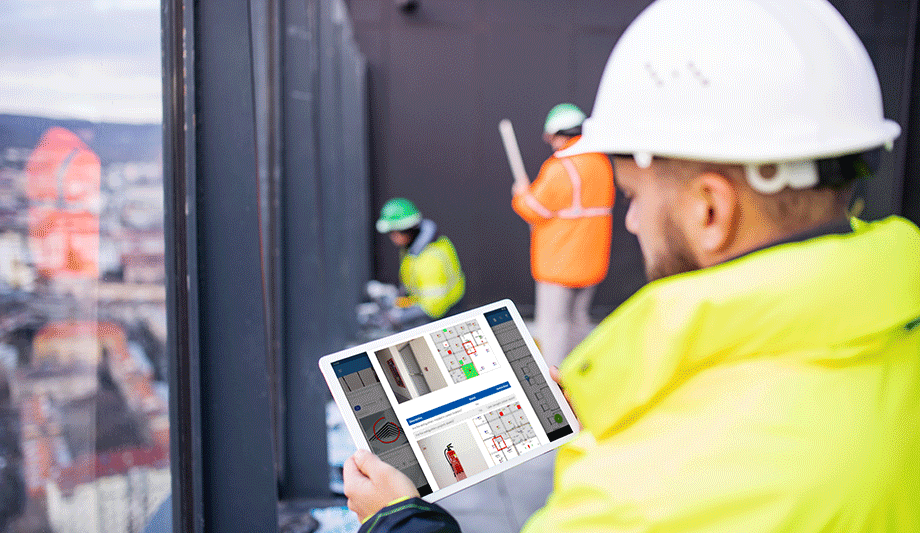
A Digital Platform to Improve Fire Safety Compliance and Inspections
Download
Overcoming the Challenges of Fire Safety in the Paper Industry
Download
Carbon Monoxide: Creeping Killer Caught In The Act
Download