Under the Regulatory Reform (Fire Safety) Order 2005, it is a legal requirement for all commercial premises to conduct fire risk assessments. This mandate encompasses various sectors, including offices, retail environments, care homes, educational institutions, warehouses, factories, as well as hotels and leisure establishments.
Next year, additional rules will be enforced under The Fire Safety Act 2022 (FSA), specifying requirements for buildings with multiple residences and confirming that these rules apply to the entire building structure, external walls, and any doors segregating domestic and communal areas.
Understanding Fire Risk Assessment
Fire risk assessments serve as crucial fire prevention tools, designed to identify potential risks within a workplace and enhance fire safety measures to protect both people and properties.
A comprehensive fire risk assessment comprises five key steps:
- Identify the fire hazards
- Identify people at risk
- Evaluate, remove, or reduce the risks
- Record findings, draft an emergency plan, and provide training
- Review and update the assessment regularly
If the business employs five or more people, or if it is licensed under an enforceable law, the fire risk assessment must be documented in writing. Additional guidance on what to include in the assessment is available.
The Role of a Responsible Person
UK government mandates that a "responsible person" must oversee fire safety in non-domestic properties
The UK government mandates that a "responsible person" must oversee fire safety in non-domestic properties.
Depending on the circumstances, this person could be an employer, the property owner, a landlord, or anyone else who controls the premises, such as a facilities manager or risk assessor.
If multiple individuals share this responsibility, they must collaborate to fulfill their obligations.
Consequences of Neglecting Fire Risk Assessments
Local fire and rescue authorities inspect premises to ensure that appropriate fire risk assessments and preventive measures are in place. They can issue three types of notices if they deem the safety standards inadequate: alterations notice, enforcement notice, and prohibition notice.
Penalties for failing to comply with fire safety regulations can be severe. Minor infringements may result in fines up to £5,000, while major violations can lead to unlimited fines and a maximum prison sentence of two years. More broadly, neglecting regular and thorough fire risk assessments poses significant danger to workplaces and individuals.
Assistance with Fire Risk Assessments
While individuals can perform the assessments themselves using standard guides, those lacking the time or expertise are advised to enlist a 'competent person,' such as a professional risk assessor, to assist them. The local fire and rescue authority is not able to conduct these assessments on their behalf.
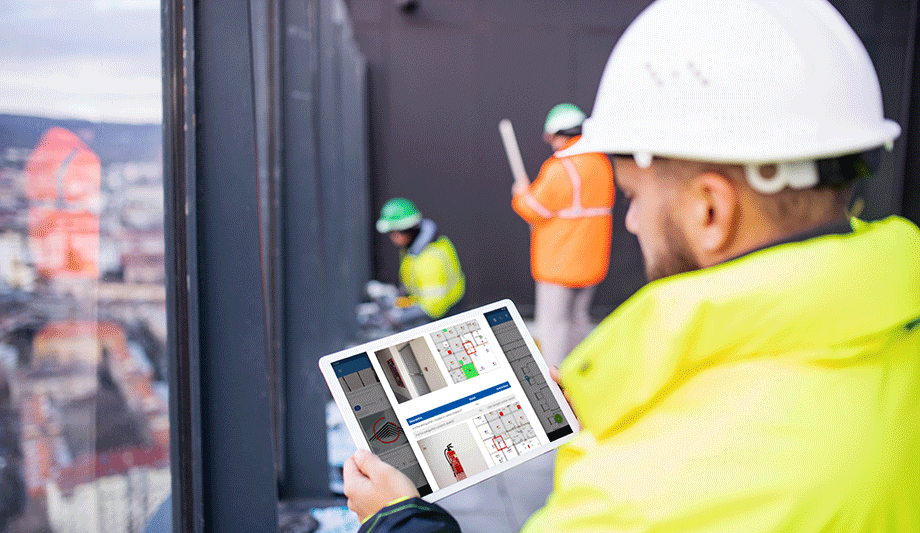
Total Fire Group offers support for conducting compliant fire risk assessments. They serve various sectors with their innovative software, Aurora, which streamlines even the most complex assessments.
Additionally, they provide ongoing consultancy services, including initial assessments and in-depth support, which are particularly beneficial for clients managing multiple properties or requiring mediation following inspections or enforcement actions by the Fire Service.
Under the Regulatory Reform (Fire Safety) Order 2005 a fire risk assessment is required by law for all commercial premises. All commercial sectors need to carry out fire risk assessments which include, but are not limited to offices, retail spaces, care homes, schools, warehouses and factories and hotel and leisure spaces.
Additional regulations are set to come into force next year under The Fire Safety Act 2022 (FSA). These regulations clarify what is needed in buildings that contain more than one residence, and clarify that the arrangements set out in the FSO apply to the entire structure of a building, the external walls, and any doors that separate domestic and common parts of a building.
Fire risk assessment
A fire risk assessment is a fire prevention tool that is used to understand the potential risks of a workplace, and then improve any relevant fire safety precautions to keep people and workplaces safe.
There are 5 parts to a complete fire risk assessment:
- Identify the fire hazards
- Identify people at risk
- Evaluate, remove, or reduce the risks
- Record the findings, prepare an emergency plan, and provide training
- Review and update the fire risk assessment regularly
If five or more people work at the premises or the business has a license under an enactment in force, users will need their fire risk assessment to be a written record. Find out more about what to include in the fire risk assessment.
Responsible person
The UK government states that a commercial fire risk assessment needs to be carried out by a “responsible person.” This person is responsible for fire safety in business or other non-domestic premises and including:
- An employer
- The owner
- The landlord
- Anyone else with control of the premises, for example, a facilities manager, building manager, managing agent, or risk assessor”
If there’s more than one responsible person, they have to work together to meet the responsibilities.
Failure to conduct a fire risk assessment
The local fire and rescue authority visits premises to check that the fire risk assessment and fire prevention measures are appropriate and can take action if they think the fire safety measures are not adequate.
There are three types of notices that they can give people:
- Alterations notice
- Enforcement notice
- Prohibition notice
- Users can also be issued with penalties for failing to follow fire safety regulations. Minor penalties can be up to £5,000. Major penalties can include unlimited fines and up to 2 years in prison.
- But more generally, failing to conduct regular and thorough fire risk assessments puts the workplace and people at serious risk.
Getting help
People can do the fire risk assessment themselves with the help of standard fire safety risk assessment guides; however, if they feel like they don’t have the time or relevant expertise to do so thoroughly, they need to appoint a ‘competent person’ to help, for example, a professional risk assessor. The local fire and rescue authority cannot carry out risk assessments for people.
Total Fire Group can help users conduct their fire risk assessments to ensure they’re fully compliant. They work with clients across a range of sectors, and their innovative fire risk assessment software, Aurora, simplifies and speeds up even the most complicated assessments.
They can also offer an ongoing fire consultancy service, which includes the initial fire risk assessment(s), as well as more in-depth support. This is more suited to clients with several properties or where mediation with the Fire Service is required following an inspection or enforcement notice being served.