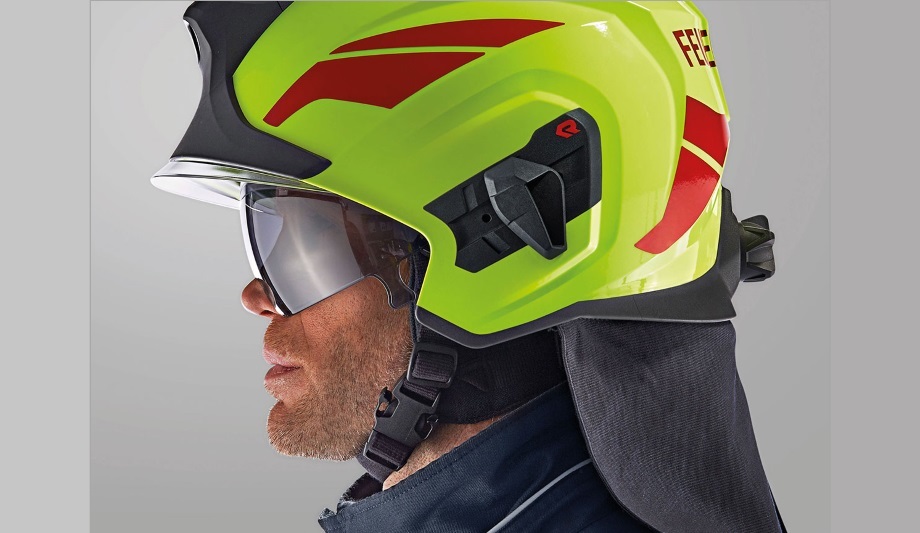

HEROS firefighting helmets from Rosenbauer for operations in buildings belong to the highest protection category in the field of personal protective equipment. They protect against deadly dangers and prevent irreversible damage. Special emphasis is placed on facial and eye protection. Burns, scars or other injuries in this area can have lifelong consequences for an individual. In order to provide the best possible protection and visibility, the visors of Rosenbauer helmets must comply with the following requirements:
EN14458:2018 certification
A type examination and continuous quality control by internal personnel and external inspection bodies alike is required for the visors on HEROS helmets. They meet the following performance levels:
- Optical Class I
HEROS-titan with clear face shield
The optical class provides information about the refractive effect of the viewing pane, taking into account spherical, astigmatic, and prismatic effects. This is the highest class and ensures visual clarity with minimal distortion. This is a prerequisite for extended periods of work with a visor, since visors with lower classes bring with them an increased risk of headaches, dizziness, and similar complaints.
Electrical properties E1 & E2
In the case of the HEROS helmets no electrical penetration may occur between the exterior, interior or along the surface
Visors must conform to the electrical characteristics used to test the intended helmets at a minimum. In the case of the HEROS helmets – and therefore also the corresponding visors – no electrical penetration may occur between the exterior and interior or along the surface (maximum leakage current of 1.2 mA at a test voltage of 1,200 V).
HEROS-titan gold coated face shield
With flame temperatures of above 1,000 °C and extreme cold to -40 °C, these are arguably the toughest requirements for the special plastic of the visors. The high-performance polycarbonate used here must, on the one hand, be flame-retardant and, after exposure to a flame of over 1,000 °C for 15 seconds, the after-burn must not exceed 5 seconds. On the other hand, the visor must be able to withstand the mechanical stresses applied in tests such as the ballistics test, even in extreme cold (-40 °C).
Resistance to fogging and increased abrasion resistance
Humid breathing air in combination with a cold visor surface usually causes condensation (fogging) on the visor. But this is not the case with HEROS visors. A special coating is applied to the inside, thus preventing any fogging. In addition to the anti-fog coating on the inside, an anti-scratch coating is applied to the outside of the visors. This gives the visors higher resistance to friction from small particles and thus increased protection against scratching.