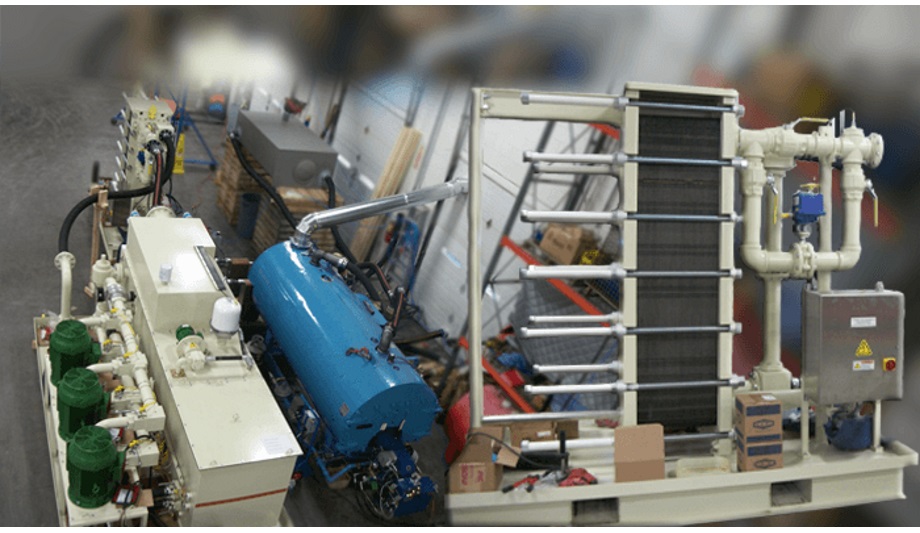

Facing a unique combination of challenges, an OEM came to GS Global Resources while creating a 3300-horsepower rock crusher, one of the largest open pit cone crusher in the world. Aside from its size, the cone crusher would also be located in Zambia, facing multiple environmental issues including extremely high ambient temperatures and caustic water supply.
Due to the hot climate, the large air coolers traditionally used in this application would not be able to effectively remove heat from the machine oil. Looking to water coolers, this OEM would normally use a shell and tube heat exchanger.
Flat plate heat exchanger
However, to be fully effective, this application would have needed 12 10” shell and tube heat exchangers, which would have been an incredibly massive set up. GSGR was tasked with developing a different, more efficient cooling method that could be proven to handle this unique set of environmental concerns.
The GSGR engineering team proposed utilizing a flat plate heat exchanger, a technology that had yet to be used in the mining industry. Since this type of solution offers much more flexibility than shell and tube systems in terms of the amount of heat that can be extracted, it could be adjusted to work in the extremely hot climate.
Titanium plates
One issue that came up with this solution, however, was the acidity of the local water supply
One issue that came up with this solution, however, was the acidity of the local water supply. As the water used in this application was so caustic that it would eat away at the stainless steel plates typically used in this type of heat exchanger, GS engineers substituted them for titanium plates, which were durable enough for the water supply.
To test this new solution, GSGR engineers created a very complex procedure to recreate the environmental constraints and operational issues they created.
They simulated the heat load of the rock crusher and ran the lube unit using the flat plate heat exchanger with water that had been heated to temperatures up to 93° F, which was 8° higher than the hottest estimated temperatures in the machine’s environment.
Monitoring water and oil temperature
This elaborate testing set up allowed for monitoring water and oil temperature changes across the cooler and guarantee that this next cooling technology would perform well for this OEM.
The OEM was able to launch this solution in the field with confidence that it could efficiently perform its intended function in temperatures even higher than what was required. Opened up the possibility to utilize a newer, more durable and size efficient technology, and has done so in 4 more machines.

- Fire Safety Risk Assessment
- Fire Safety Planning
- Fire Prevention
- Fire Detection
- Fire Protection
- Fire Safety Inspection
- Fire Safety Testing
- Fire Safety Standards
- Fire Safety Policies
- Fire Safety Management
- Electrical Fire Safety
- Building Fire Safety
- Industrial Fire Safety
- Active Fire Protection (AFP)