
Liferaft servicing is a critical aspect of maritime safety, ensuring these essential life-saving devices are always ready for use. With decades of expertise, VIKING is a trusted pioneer in liferaft maintenance, offering comprehensive solutions through a global network of over 280 certified service stations in key shipping hubs and offshore locations.
Skilled technicians ensure high-quality servicing under strict safety standards, with the process covering three key steps: Documentation, Service, and Testing.
Documentation: The Foundation of Liferaft Servicing
Every detail of the service is meticulously recorded and archived, ensuring traceability
The documentation process is integral to every stage of liferaft servicing, ensuring that every action taken is accurately recorded and fully compliant with maritime safety standards. It begins when the liferaft is received and registered, with its details logged for tracking purposes. The onboard logbook is completed, confirming that the liferaft has been opened, inspected, and tested.
Following a thorough inspection guided by VIKING's approved checklist, a re-inspection certificate is issued, verifying that the liferaft meets all regulatory standards. Every detail of the service is meticulously recorded and archived, ensuring traceability and compliance with safety requirements. To close the process, customers receive a detailed invoice, offering transparency and clarity for the work completed. With proper documentation as the foundation, the servicing process moves forward seamlessly, prioritizing safety and reliability every step of the way.
Service: Ensuring Liferaft Readiness
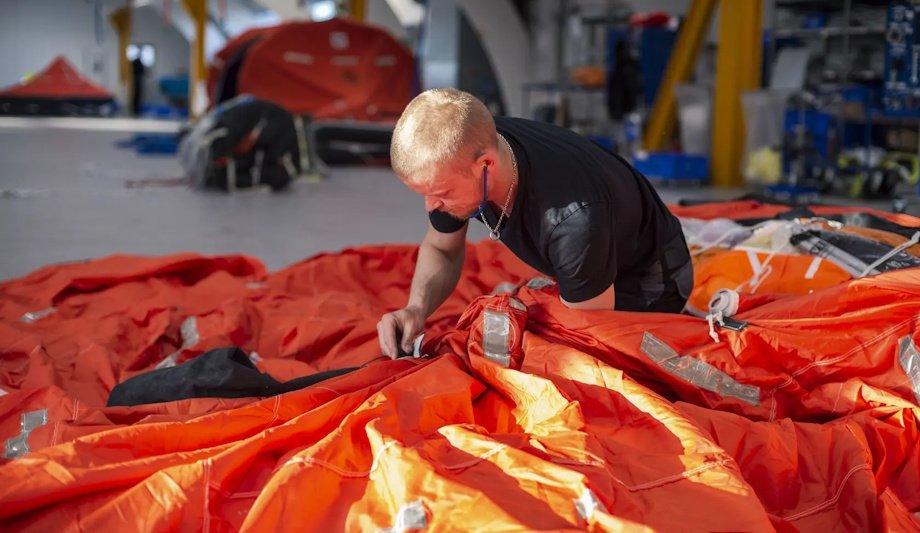
The service process is where a liferaft is carefully examined and maintained to ensure it meets the highest safety standards. It begins with the opening of the container and the careful disassembly of the inflation system. Once the liferaft is removed, the container itself is thoroughly cleaned, and any necessary fiberglass repairs are made to maintain its integrity. The container is then relabeled, ensuring it is ready for future use.
The liferaft is thoroughly inspected, both inside and out, with each component checked for wear and proper function. The emergency pack is reviewed, and any expired items are replaced to meet safety regulations.
Key equipment of the inflation system
Service process ensures that the liferaft is fully functional, ready for deployment, and in full compliance
Key equipment—such as the operating head, valve, knife, and release wire—is carefully examined and replaced if needed. The inflation system and high-pressure hoses are also checked, while the CO2 cylinder is tested to ensure it contains the correct amount of gas.
Once all components are confirmed to be in top condition, the liferaft is deflated, repacked into the container, and prepared for dispatch. The service process ensures that the liferaft is fully functional, ready for deployment, and in full compliance with safety regulations.
Testing: Ensuring Liferaft Performance and Safety
The testing process is a critical step in verifying that a liferaft will function effectively in an emergency. During service, the liferaft is inflated using compressed air and subjected to a series of rigorous pressure tests. This includes a 60-minute working pressure test for the lower buoyancy chamber, upper buoyancy chamber, and arch chamber to ensure they can withstand the necessary conditions.
If the liferaft is equipped with an inflatable floor, it undergoes a similar 60-minute pressure test. Additionally, liferafts are tested at specific intervals as required by international regulations. Every five years, a gas inflation stress test (GI) is conducted using the liferaft’s own CO2 cylinder to simulate real-world conditions.
Liferaft servicing
FS is also carried out at 10 years, and then annually, to check the integrity of the internal floor seams
At 11 years, an additional pressure test (NAP) is performed at double the working pressure rate, with annual testing required thereafter. A floor seam test (FS) is also carried out at 10 years, and then annually, to check the integrity of the internal floor seams.
These thorough tests ensure that the liferaft remains fully operational, providing the utmost confidence in its performance when needed most.
Liferaft servicing is a crucial process that ensures these life-saving devices are always ready for deployment. Through a comprehensive approach—encompassing detailed documentation, thorough servicing, and rigorous testing—VIKING works meticulously to enhance the performance of liferafts. With careful inspection, precise maintenance, and exhaustive testing, they provide their customers with peace of mind, knowing their liferafts will perform when it matters most.
VIKING recommends regular servicing of the liferaft
This will extend the life expectancy of the liferaft - but most importantly it is the guarantee that the liferaft works perfectly in a situation where it can mean the difference between life and death.