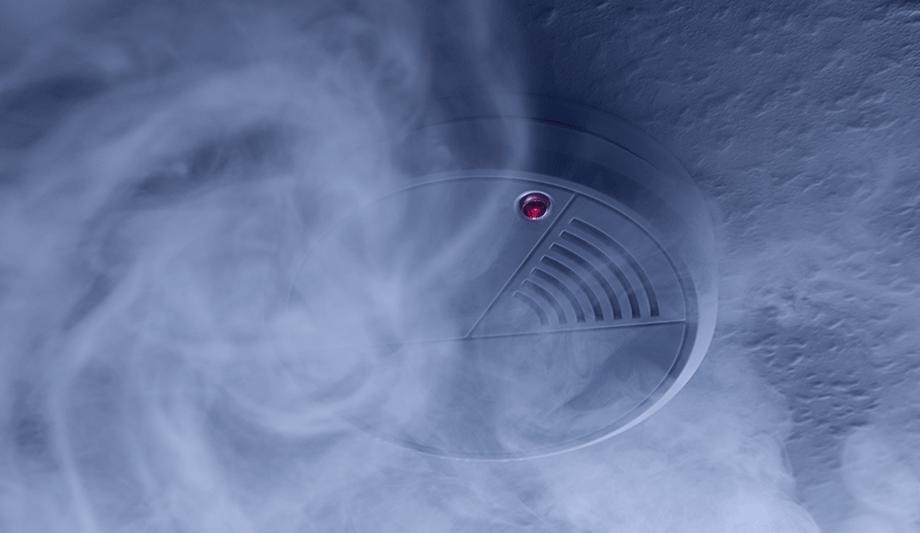
The smoke alarms in homes might be both ridiculously sensitive and ridiculously loud. They might go off even when there's no smoke, and users scramble up on top of a chair to reset them, because a pot of boiling water is producing steam. So how do these things work?
Ones there is an ionization chamber with two plates and a source of ionizing radiation. The alarm's battery sends a voltage to the plates, charging one positive and one negative. The radiation supply, few amounts of an isotope called Americium-241, decays and emits alpha particles at a definitive, persistent rate.
Once the particles travel through the chamber, they ionize or knock an electron from the oxygen and nitrogen atoms in the air that pass through the chamber.
Newly free electrons
The newly free electrons, which have a negative charge, are attracted to the positively charged plate, and the now-positively charged atoms are attracted to the negative plate. This maintains a tiny amount but constant current between the two plates. When smoke enters the chamber, it disrupts this little movement of ionization and lowers or kills the current between the plates, triggering the alarm.
Some disadvantages to ionization detectors are that the radioactive isotope needs proper disposal of old detectors so that they don't cause a hazard, and it's very sensitive. Simple Explanation: When smoke gets into the detectors and blocks the ELECTRICAL CURRENT, the alarm sounds.
Light-emitting diode
It has a light-emitting diode that sends a beam of light across the top of a T-shaped chamber
It has a light-emitting diode that sends a beam of light across the top of a T-shaped chamber. At the bottom of the T is a photocell that detects light.
When smoke enters the chamber, the light hits it, spreads into the base of the T and strikes the photocell. When a definite amount of light hits the cell, it triggers an electrical current that sets the alarm off.
These detectors aren't as sensitive as the ionization ones and are designed to detect slow, smoldering, smokier fires. Once a certain amount of light hits the cell, it triggers an electrical current that sets the alarm off. These detectors aren't as sensitive as the ionization ones and are designed to detect slow, smoldering, smokier fires.
Smoke alarm systems
Simple Explanation: Once smoke blocks the LIGHT RECEPTORS of this kind of unit, an alarm sounds. Probably the most comprehensive method to protect the home is by utilizing an alarm, which utilizes both methods of detection.
Combination smoke detectors remove the guesswork involved in choosing the best type of device for every aspect of the home or facility because they've got it all covered: ionization detection for low, sudden smoke flame-ups, and photoelectric sensors for smoky, slow-burning fires.
To ensure the home or facility is completely protected from fire emergencies, talk to FCF, an experienced fire safety expert who can help determine the types of smoke alarm systems users need and if they want to ensure the fire safety throughout the years, trust FCF.