London Fire Brigade - Experts & Thought Leaders







Latest London Fire Brigade news & announcements

London Fire Brigade has submitted a planning application for the refurbishment of its site at 8 Albert Embankment. The application also includes plans to modernize Lambeth Fire Station, which forms part of the building. The building at 8 Albert Embankment was constructed by the Brigade in the 1930s as a combined fire station and office block. The fire station occupies the ground and first floors of the building, with six floors of office space above. Brigade’s own estate The office space was used as the Brigade’s headquarters until 2008, when it was relocated to Southwark. It is currently vacant, and the plans will make use of the Brigade’s own estate, rather than continue leasing commercial property. The proposed plans will see the building's vacant office space refurbished and brought back into service. These offices will become home to the essential support services that make up the Brigade’s headquarters function. Remodeled accommodation for firefighters Alongside the renovated office space, work will be carried out to upgrade and refit Lambeth Fire Station. This will include new equipment stores and workspaces, as well as remodeled accommodation for firefighters. As a Grade II listed structure, extra care will be taken to preserve key historic elements found in the building's original design. The training space in the yard and drill tower will also receive investment, and the appliance bays will be adapted to accommodate specialist vehicles if required. As a part of the proposals, a new space will be created, centered around the Brigade’s existing Memorial Hall, where the sacrifice of fallen London firefighters is remembered. This space will allow the Brigade’s historic collection to be displayed, which will be used for educational purposes and community outreach. There will also be a community room for local residents and groups to use. Series of consultations with the local community To ensure the views and needs of nearby residents and the local community were considered, the Brigade conducted a series of consultations with the local community prior to submitting this planning application, which follows a thorough options appraisal. London Fire Commissioner Jonathan Smith said: “Moving our headquarters back to its historic location in Lambeth is not just the right decision for the Brigade, but also for London and Londoners. By refurbishing and modernizing an existing building, we will be offering the best value for Londoners and maintaining an important presence on the Thames and in the heart of London." “These plans will deliver an upgraded fire station to serve the people of Lambeth as well as some of London’s most celebrated locations.”
The Door & Hardware Federation (DHF) has once again endorsed its commitment to fire safety by supporting Fire Door Safety Week, the national awareness campaign first launched in 2013 in response to widespread neglect of fire doors. The Fire Door Safety Week initiative was created to raise public understanding of the vital role that fire doors play in protecting life and property. Quality standards to proper installation Something as simple as propping a fire door open can prevent it from doing its job in the event of a fire The campaign is owned, managed and run by the British Woodworking Federation and is supported by a number of partners, including the Home Office’s National Fire Safety campaign, the National Fire Chief’s Council and the London Fire Brigade. This year’s campaign will take place from 22 to 26 September 2025. For a fire door to perform effectively, every stage must be right. From correct product manufacture and quality standards to proper installation and ongoing maintenance, the detail matters. How fire doors are specified, managed and used can quite literally mean the difference between life and death for building occupants. Something as simple as propping a fire door open can prevent it from doing its job in the event of a fire. Duty of ensuring fire doors Responsibility does not lie with one group alone, however. Manufacturers, installers, building owners and users all share the duty of ensuring fire doors remain fit for purpose. This principle of shared responsibility is the driving force behind Fire Door Safety Week. As part of its ongoing commitment, DHF has recently launched the Ironmongery Manufacturers’ Guidance Document, developed with the Guild of Architectural Ironmongers (GAI). Information for fire door hardware New industry-led best practice guide provides clear, consistent and comprehensive product information This new industry-led best practice guide provides clear, consistent and comprehensive product information for fire door hardware placed on the market in the UK that is not already covered by harmonized or designated standards. Developed over more than a year in collaboration with the Office for Product Safety and Standards (OPSS), the document supports manufacturers, distributors and own branders in meeting their obligations and ensuring safe, effective product selection, installation and maintenance. fire door safety, inspection and ongoing maintenance DHF has also partnered with BRE to deliver a series of one-day training courses on fire door safety, inspection and ongoing maintenance. With some contractors still falling short in their inspections, it is essential facilities and property managers fully understand their responsibilities in relation to fire door maintenance. “We are, once again, very pleased to support Fire Door Safety Week, and continue to back its on-going objectives,” says DHF’s Director of Commercial Operations, Patricia Sowsbery-Stevens, adding “Through our guidance work, industry partnerships and training initiatives, we will continue to raise awareness of the crucial role that fire doors play in saving lives and protecting property.”

Sabrina Cohen-Hatton has been appointed as the new Chief Fire Officer to lead Hampshire and Isle of Wight Fire and Rescue Service, becoming the organization’s first female chief. Set to start her new role later this year following a handover period with current Chief Fire Officer, Neil Odin, Sabrina joins them from her position as chief of the neighboring fire service in West Sussex. Prior roles of Sabrina Sabrina, who has previously held senior fire service roles with London Fire Brigade and Surrey Fire and Rescue Service Sabrina, who has previously held senior fire service roles with London Fire Brigade and Surrey Fire and Rescue Service prior to joining West Sussex in 2019, was awarded the King’s Fire Service Medal for distinguished service and gallantry in the 2023 Birthday Honors. Speaking of her appointment, Sabrina said: “I am truly honored to have been appointed to lead Hampshire and Isle of Wight Fire and Rescue Service and am incredibly excited to begin this new role to ensure that the Service continues to deliver for the residents of Hampshire and the Isle of Wight." Service’s improvement plan Sabrina added: “I would like to formally put on record my thanks to the Service’s current Chief Fire Officer, Neil Odin, who I have been privileged to work alongside for many years. I know that his time leading the Service will leave a lasting legacy that I will work with to ensure that residents in Hampshire and the Isle of Wight are kept safe from the risk of fire and emergencies." “I am incredibly proud of the time that I spent at West Sussex Fire & Rescue Service, where I was equally as privileged to work with some incredible people as we worked together to deliver the Service’s improvement plan. It is with a heavy heart that I leave the Service, but know that I am leaving the Service in safe hands and I take with me many fond memories and friendships." “I am very much looking forward to working with all colleagues at Hampshire and Isle of Wight Fire and Rescue Service to uphold all of the fantastic work that all of its teams deliver each and every day to keep the residents living and working in its communities safe.” Chief Fire Officer for Hampshire and the Isle of Wight Hampshire and Isle of Wight Fire Authority Chairman, Cllr Rhydian Vaughan MBE said: “I am pleased to announce the appointment of Sabrina as our new chief fire officer for Hampshire and Isle of Wight. The role of chief fire officer is one of huge responsibility, and following our rigorous recruitment process, I am certain Sabrina is the right person to lead us forward.” “I am very much looking forward to welcoming Sabrina when she formally joins us later this year. As a fire authority we look forward to working with her and to support her in being at the helm of this incredible organization." Sabrina joined South Wales Fire and Rescue Sabrina joined South Wales Fire and Rescue at 18 years old in 2001 after sharing homelessness from the age of 15 Sabrina joined South Wales Fire and Rescue at 18-years-old in 2001 after experiencing homelessness from the age of 15. Selling the Big Issue, she developed a curiosity to serve in the fire service in the hope of being able to help people when they needed it most. As well as being an ambassador for The Big Issue, she is also an advocate of Prince William’s Homewards foundation, and during her time at South Wales, led a partnership of uniformed youth groups of which HRH King Charles (then The Prince of Wales) was patron. Educational Background of Sabrina In her time working in the fire sector, Sabrina has completed numerous secondments, including to the Welsh Government, HMICFRS, interim Deputy Chief Fire Officer in Surrey and currently serves as the NFCC’s Improvement Chair and National Lead for Working Dogs. Alongside serving, Sabrina has studied psychology at both the Open University and Cardiff University, completing a PhD in Behavioral Neuroscience, and has since been awarded numerous honorary doctorates. Several significant incidents Sabrina was appointed as a Deputy Assistant Commissioner in the London Fire Brigade As well being a published author, her research into the decision-making of incident commanders has received many academic accolades and influenced policy change across the world. In 2015, Sabrina was appointed as a Deputy Assistant Commissioner in the London Fire Brigade, where she was a commander in the response to several significant incidents, including the Westminster Bridge and Finsbury Park terror attacks, and in the aftermath of the Grenfell Tower fire. Following a 34-year career in the fire service, Neil Odin is due to retire after more than seven years in the top job. Sabrina leadership skills Neil said: “As well as her commendable and notable professional successes over more than two decades, I have also had the privilege of working with Sabrina for many years." “Embodying our Service Values, Sabrina will bring a fresh outlook, strong leadership skills, and invaluable experience, ensuring the Service continues to adapt, improve and thrive. I know that she will find Hampshire and Isle of Wight a great place to work, and receive a warm welcome from the staff, partners and communities.”
Insights & Opinions from thought leaders at London Fire Brigade

A 2015 survey found that globally firefighters are the most trusted profession worldwide. The fire service provides a vital role during flood events, rescuing members of the public, who may be trapped in their homes, pumping out flooded properties, and recovering stranded vehicles. However, many would not require this assistance, if they had been better prepared prior to a flood. And such preparation could help free up emergency services resources for others. Extreme rainfall and flooding More frequent Extreme rainfall and flooding events are now occurring with increasing regularity and severity, as the impacts of climate change become more apparent. Due to the growing frequency of devastating flood events, there is now much greater acknowledgement and appreciation of the increasing risks. There is also more urgency and willingness from individuals, businesses, and within both the public and private sector, to take greater responsibility for understanding and managing flood risk. Improvement in flood risk mapping and warnings Many home and business owners are unaware that they may be at the risk of flooding The flood risk sector has come a long way, within the last 15-20 years, with improvements in flood risk mapping, warnings, and flood risk management schemes. However, there is still room for improvement. Many home and business owners are unaware that they may be at the risk of flooding. This lack of awareness means that thousands of homes and properties are not prepared for flooding. It is, typically, these individuals that are at the greatest danger, during a flood and are more likely to require assistance from the emergency services, for evacuation, rescue, or recovery. A spokesperson for the London Fire Brigade said, “Last year, I attended an incident, where a car had driven into a flooded underpass. We had to rescue all the occupants from their vehicle. This could have easily been avoided, if they had just chosen to find another route.” Increase in flood awareness Flood awareness is increasing, but to continue this trend, there is a need for a collective effort from all parties across the flood risk sector, including the emergency services. A particular area of weakness within the sector is leadership. The Pitt Review, released following the 2007 floods, endeavored to create greater clarity around response to flooding. Although, many aspects have improved considerably, there still remains ambiguity about, which agency has responsibility for the co-ordination of flood response. Assessing and managing flood risk Responsibilities for assessing and managing flood risk are split between the Environment Agency (EA) and local council authorities, referred to as Lead Local Flood Authorities, depending on the size of a water course and the nature of the flooding. Alongside this, responsibility is split further, as sewer flooding is managed by the local water authorities. This can obviously become confusing for those outside of the profession, who are seeking guidance and advice, so as to better understand their flood risks, and to protect themselves and their property. Importance of informing the public on flood risks As well as clearer sign-posting to the relevant authority, all professions that deal with and manage flood risk need to be using interactions with the public, as an opportunity to inform and educate. While the ABI (Association of British Insurers) states that any flood surveyors should be Chartered Surveyors or Civil Engineers, this is not enforced and nor is there an easily accessible register, in order to find such professionals. There is a distinct lack of ‘trusted voices’ within the sector. Protecting people and property The fire service can have a crucial role in advising home and business owners, about their flood risks Given the absence of clear guidance and leadership, across the flood risk sector, the fire service can have a crucial role in advising home and business owners, about their flood risks. Ultimately, the objective for all the emergency services personnel is the same, as every flood risk professional, which is to protect people and property. The trust that is rightly afforded to the fire service provides an ideal opportunity to offer reliable guidance and advice, ensuring that people and property can be protected from the impacts of flooding. Sufficient staffing of fire and rescue services As a result of government cuts, 11,000 firefighter posts have been lost in the United Kingdom, since 2010. While firefighters have always rescued people from floods, the services need to be properly resourced with sufficient staff, so as to deal with increasing flood risk. As a trusted voice, we believe this should include sufficient funding, so as to help raise awareness of flood risk to the public. Currently, 67% of people do not know their flood risk.

Electric bikes and scooters are a newly popular way to travel through urban environments. However, the nifty devices come with a fire risk that could be deadly. In London, firefighters have responded to more than 25 fires, involving e-bikes or e-scooters in recent months, some of them significant incidents with serious injuries. Lithium-ion batteries pose fire risks The fire hazards of e-bikes and e-scooters stem from their use of rechargeable lithium-ion batteries that can erupt into flames. Complicating the problem is use of unauthorized or third-party batteries that may not be safe. E-bike conversion kits are available to convert standard bikes into e-bikes, but they include only the motors and control gears. Batteries must be sourced separately, often over the internet and by cost-conscious buyers, who may not consider safety issues. Cheaper batteries may be faulty. Using trusted batteries and proper storage Firefighters urge residents to use only trusted batteries and to store them correctly Damaged batteries are also problematic. Spare batteries should not be knocked around, which can increase the likelihood of damage to the cells. Firefighters urge residents to use only trusted batteries and to store them correctly. In one recent incident, a first floor flat in Brixton in south London was badly damaged, after a fire was caused by a fault in the lithium-ion battery pack of a mountain bike that had been converted into an e-bike. In another incident, five people were taken to hospital, after a fire at a flat in Southwark in Central London, caused by the failure of a battery in an electric scooter on charge. In the United Kingdom, anyone over 14 years old can ride an ‘electrically assisted pedal cycle’ (EAPC) without a license and with no need to register, pay tax or ensure the bike. Parameters for e-bikes in the UK The bike must meet certain requirements, such as displaying the power output and motor manufacturer, showing either the battery voltage or the maximum speed of the bike, and having a maximum power output of 250 watts. The electric motor should not be able to propel the bike, when it’s traveling more than 15.5 mph. Assuming a bike (or vehicle with more than two wheels, such as a tricycle), meets the requirements, it is classified as a normal pedal bike and can be ridden on cycle paths, and anywhere else where pedal bikes are allowed. E-scooters for emission-free transport E-scooters are stand-up, electrically powered scooters that are becoming more popular in urban environments E-scooters are stand-up, electrically powered scooters that are becoming more popular in urban environments, providing individual and emission-free transport. In a city like London, e-bikes are a familiar sight. Riders may store and charge their e-bikes in communal areas or hallways, when they are home. This practice heightens the fire danger, because any fire that erupts is likely to block an escape route and trap occupants within the building. Avoiding unsafe mixing of batteries and chargers The London Fire Brigade’s Fire Investigation team has seen incidents involving multiple batteries and chargers for a number of bikes at one property, which has resulted in the unsafe mixing of batteries and chargers. Lithium-ion batteries are susceptible to failure, if charged incorrectly, which may be a contributing factor in some incidents. Batteries can get warm during use and should be allowed to cool down, before attempting to re-charge. They should also be charged on hard, flat surfaces, in order to allow heat to dissipate. Chargers and batteries should not be left unattended or while residents are asleep. Installation of smoke alarms is advisable in areas where e-bikes or e-scooters are being charged.
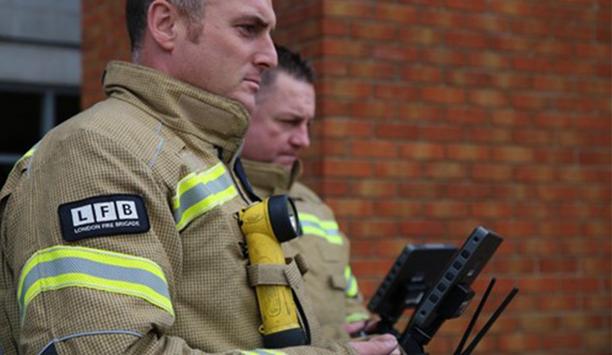
Drones give Incident Commanders an aerial view, increasing their situational awareness of fires and helping them to develop tactics to tackle them. Station Officer Lee Newman details how the technology was implemented by London Fire Brigade and the continued benefits. Identify external risks The Grenfell Tower fire has resulted in revisions to several operational procedures and the introduction of new equipment within the Brigade. A few months after the fire, the Brigade was tasked with setting up a trial to test the feasibility of having a drone capability to identify external risks and assess building stability at incidents, providing essential safety information that could facilitate ongoing internal firefighting operations. Implement the use of drones The Brigade implemented the use of drones and acquired a Matrice 210 V1 and a Phantom 4 Working with partners who had an existing drone capability, as well as drone experts, the Brigade began work to implement the use of drones and acquired a Matrice 210 V1 and a Phantom 4 as a trainer and reserve drone. In the summer of 2018, an Emergency Services bespoke course was run by Essex Police to train the Brigade’s team of drone pilots, who were all PfCO qualified within one week. From start to finish, it took just nine months to get London Fire Brigade’s drone team operational. Working of the drones On its first day of being available for incidents, the team received an order to attend a 15-pump fire at a leisure center, which was under renovation. They were asked to confirm if there were cylinders on the roof of the building and immediately put the drone to use. The team flew and relayed the camera footage onto a large screen that was fitted into a van provided for the trial. The drone footage was able to identify, to the Incident Commander’s satisfaction, that the cylinders were actually rolls of asphalt due to be laid on the roof as part of the renovation. If the drone concept could have proven its use in one job, this was it. The information from the drone allowed the Incident Commander to decide not to make it ‘cylinders confirmed’ and saved a lot of unnecessary extra appliance movements. Applications of drone Since that first callout, the team has been to around 300 incidents of six pumps or more, including persons in the water, fires, and various missing people’s incidents both in London and into other counties, assisting police forces. From start to finish, it took just nine months to get London Fire Brigade’s drone team operational Drone inventory The Brigade’s drone capability inventory includes a Matrice 300 with an H20T dual thermal and optical camera; a DJI Mavic 2 Enterprise Dual with multi attachments; a Mavic Air 2 and a Yuneec 520. The Brigade also has a Teradek live streaming device and multiple tablets for receiving the streamed footage. The Brigade operates with two Mitsubishi Outlander PHEVs – plug-in hybrid SUVs – and has split the drone equipment into two, with one vehicle carrying the drone and batteries, and the other carrying all the support kit and ancillaries. Working in dark conditions The drones are permitted to fly up to 400 ft above ground level or higher in an emergency and can fly as fast as 50 mph. They also can act as a loudspeaker to give instructions or reassurance and shine a bright spotlight in dark or low light conditions. 24/7 service The Brigade has eight pilots trained and operates a 24/7 service The Brigade has eight pilots trained and operates a 24/7 service. The team is working closely with its blue light partners, including the: Metropolitan Police Service, several search and rescue teams, and a host of fire services surrounding the capital, as well as giving advice to other upcoming drone teams around the UK. Use of drone in future The Brigade’s drone capability has been molded to how it sees the future and what it holds in the way of drone use. For example, the Brigade has developed a capability to drop water rescue aides to people at water incidents, which helps to keep them afloat long enough to be rescued. The drone can also be used alongside the swift water rescue teams to provide situational awareness of hazards and the resulting risks during the rescue phase. Delivering fire escape tools The Brigade also invested in fire escape hoods in late 2018 and has already demonstrated how one might be delivered via a drone to a balcony above the height of an aerial appliance while using the Mavic Enterprise 2 to relay instructions via the loudspeakers. These possible new uses are pushing the boundaries of the Brigade’s original concept and demonstrate how London Fire Brigade works to stay ahead of the curve.
The New Future For Fire Agencies
Download
The Eight Key Trends in Fire Detection in 2023
Download
A Digital Platform to Improve Fire Safety Compliance and Inspections
Download
Overcoming the Challenges of Fire Safety in the Paper Industry
Download
Carbon Monoxide: Creeping Killer Caught In The Act
Download