Apollo Fire Detectors Ltd - Experts & Thought Leaders






















Latest Apollo Fire Detectors Ltd news & announcements

The University of Southampton, a multi-campus estate with a research institution, has recently enhanced its fire safety provision for deaf and hard-of-hearing individuals through a pioneering paging system installation. Advanced’s MxPro 5 fire panels, integrated with the ESPA Pager Interface, form the core of the new solution delivered by Premier Fire Security and Scope Communications, providing targeted alerts and improved accessibility across the university. Traditional audio alarms With over 200 Advanced panels deployed across the site, including two networks of 30–40 nodes and a growing number of extinguishing panels, the university required a solution that could deliver precise, location-specific fire alerts to individuals without relying on traditional audio alarms. The ESPA 4.4.4-compliant Pager Interface from Advanced provided the ideal bridge between the fire detection system and Scope’s PageTek Pro Mk2 transmitter and EPOCBLUM pagers. The system is configured so that each building or group of buildings triggers a distinct pager address. This ensures that only relevant alerts reach the end user, reducing confusion and improving response times. Users can manually program their pagers to activate or deactivate specific locations, with password protection for added security. For nighttime safety, Scope’s pillow pad and nightstand accessories ensure that alerts are received even while users are asleep. Dedicated paging group Chris Chance, University of Southampton Contract Manager at Premier Fire Security, explained: “We’ve worked closely with Scope and Advanced to create a system that’s not only reliable but incredibly flexible. The ability to configure pagers for any location means we can reduce hardware stock and improve coverage across the entire campus. It’s a huge step forward in inclusive safety.” The installation also includes a dedicated paging group for engineers, janitors, security, and fire marshals, who receive diagnostic and fault messages from the Advanced network. This group can also trigger fire messages for specific locations, enhancing operational control and coordination. Enhancing operational control Rob Baker, Head of Technical Support at Scope Communications, added: “This project demonstrates how powerful the ESPA interface can be when paired with our paging technology. The system ensures that alerts are both accurate and accessible, and we’re proud to support Premier Fire Security in expanding this solution across the university.” The long-term vision is to roll out the paging system to all student halls, allowing pagers to be reconfigured for use anywhere on campus. This approach not only improves safety but streamlines inventory and reduces costs. Delivering tailored fire alerts Salvy Vittozzi, Regional Sales Manager for the South East at Advanced, commented: “This installation is a great example of how our ESPA Pager Interface can be used to deliver tailored fire alerts in complex environments. It’s rewarding to see our technology helping to make campuses safer and more inclusive for all users.” By combining Advanced’s robust fire panel technology with Scope’s innovative paging solutions, the University of Southampton now benefits from a highly adaptable, inclusive fire safety system, one that’s already being expanded to meet the evolving needs of its diverse community. Intelligent fire systems As a pioneer in the development and manufacture of intelligent fire systems, Advanced products are specified in locations around the world, from single-panel installations to large, multi-site networks. The Advanced portfolio includes complete fire detection systems, multiprotocol fire panels, extinguishing control, false alarm management and reduction systems as well as emergency lighting. Advanced is owned by FTSE 100 company Halma PLC – a global group of life-saving technology companies with a clear purpose to grow a safer, cleaner, healthier future for everyone, every day.

Joining the team in September, Kate brings a wealth of international leadership experience and a strong record of driving growth and innovation across global organizations. Before joining Apollo, Kate has had an illustrious career in senior leadership positions across many industries, including security, retail, and healthcare, where she played a key role in shaping global strategy and fostering innovation across multiple markets and channels, at both a start-up and multinational level. Kate's leadership style Kate leadership style is collaborative, people-focused, and results-driven — qualities that align perfectly with Apollo’s values and culture. Since stepping into her new role, Kate has immersed herself in meeting our teams, customers, and partners. She has shared that she’s “really enjoying getting to know the team” and is “really proud to be working with such a talented group of people,” reflecting her enthusiasm and inclusive approach to leadership – and the team has enjoyed getting to know her more. Diversity and inclusion across the fire safety industry Kate also recently attended the Women in Fire Safety Awards 2025 alongside members of the Apollo team, where we were proud to win the Inclusive Company Award. The event celebrates and recognizes progress in diversity and inclusion across the fire safety industry — a cause close to Apollo’s heart and one that reflects the ongoing commitment to building a more equal and representative industry. next chapter in the journey Under her stewardship, Apollo will continue to strengthen its position as a trusted pioneer in fire detection — building on the reputation for quality, reliability, and innovation. They warmly welcome Kate to Apollo. Her energy, experience, and vision equip them well for the next chapter in the journey to keep people safe from fire every day.

Renowned fire and life safety solutions manufacturer, Advanced, has won an award at the 2025 Fire & Security Matters (FSM) Awards, recognizing its achievements in fire safety, customer service, innovation, and sustainability. At the ceremony, held at Coventry’s CBS Arena on 5th June, Advanced won the award for Fire Safety Project of the Year, and was also commended in the Fire Safety Manufacturer of the Year category. Modernize fire safety Advanced’s double win at last year’s FSM Awards and mark a significant milestone in its ongoing mission These accolades follow Advanced’s double win at last year’s FSM Awards and mark a significant milestone in its ongoing mission to create a safer, more sustainable future. Advanced’s installation of its AdvancedLive system at Blists Hill Victorian Town earned the company Fire Safety Project of the Year. Delivered in partnership with Chubb Fire & Security, the project showcased how cutting-edge technology can be tailored to meet the challenges of a historically sensitive, multi-structure site. Wireless connectivity, intuitive controls, and a bespoke visual interface helped modernize fire safety across the landmark site without compromising its heritage. Fire system management Meanwhile, the judging panel commended the strength and innovation behind Advanced’s next-generation MxPro 5 fire panel, which played a key role in earning recognition in the Fire Safety Manufacturer of the Year category. Featuring a faster processor, improved configuration speeds, and seamless integration with AdvancedLive, the panel highlights the company’s commitment to smarter, more connected fire system management. Combined with continued investment in product development and responsiveness to market needs, these advancements helped distinguish Advanced in a highly competitive category. R&D and customer support Combined with continued investment in product growth and responsiveness to market needs Commenting on the awards, Advanced Managing Director, Antonio Telesca, said: "To be recognized at this year’s FSM Awards is an incredible achievement and a reflection of the hard work, talent, and passion of our entire team." He adds, "These awards celebrate every department across the business, from R&D and customer support to sustainability and project delivery, and I’d like to thank our customers and partners for their continued trust and support." Innovation and achievement The 2025 FSM Awards brought together over 400 fire and security professionals to celebrate innovation and achievement across the sector. Representing Advanced at the event were Salvy Vittozzi, Phil Calvey, Paul Duffy, Rachael Houghton, Mark Ramshaw, Paul Taylor, Conor MacLeod, and Sarah Yule.
Insights & Opinions from thought leaders at Apollo Fire Detectors Ltd

Since the Grenfell tower tragedy in 2017, residential high-rise fire safety has become a top priority for tower block building managers. If a high-rise building is found to contain combustible cladding, then the standard ‘stay put’ policy is no longer considered safe, and instead a temporary ‘simultaneous evacuation’ strategy must be put in place until the cladding issue is resolved. Currently a Waking Watch protocol is the preferred option for ensuring resident’s safety, in order to coordinate a simultaneous evacuation in the event of a fire. But, due to the extremely high cost of Waking Watch, Fire Detection & Alarm systems are being used to help reduce and, in some cases, remove these costs, which can amount to upwards of £100,000 per year. After the Grenfell fire, official figures showed that there are 300 towers with ‘Grenfell-style’ Aluminum Composite Material (ACM) cladding. However, there are many different types of high-risk flammable cladding used on purpose-built blocks of flats, such as timber, high-pressure laminate (HPL) and polystyrene cladding. With more and more unsafe buildings being assessed, the scale of this issue continues to grow. Currently a Waking Watch protocol is the preferred option for ensuring resident’s safety The UK Government announced in 2018 that it would pay for the removal and replacement of unsafe cladding in councils and housing associations. However, there is no legal position stating that private landlords should not pass the cost of this work onto tenants, and with the high costs of replacement, along with mounting Waking Watch costs, private landlords are known to pass this cost to tenants in service charges. Along with the cost of cladding replacement, landlords are also charging tenants for the cost of expensive Waking Watch services. Approved fire alarm systems are fast becoming the preferred safety system, due to the reduced overall costs, as well as the NFCC (National Fire Chiefs Council) recommending these over Waking Watch services. Fire safety regulations in high-rise buildings Following the Grenfell tragedy, the Government issued notice that all buildings over 18m had to be assessed for combustible material in their external walls. Following this, in January 2020, the government also issued Advice for Building Owners of Multi-story, Multi-occupied residential buildings stating that “building owners are to consider the risks of any external wall system and fire doors in their fire risk assessments, irrespective of the height of the building” immediately, until a Fire Safety Bill is put in place. Approved fire alarm systems are fast becoming the preferred safety system In order to assess the fire risk of external wall systems of residential apartment buildings an EWS1 assessment (External Wall Fire Review) must be completed. This risk assessment form provides a ‘safe’ or ‘unsafe’ certificate for the building, and must be completed by a competent fire expert. Not only does an ‘unsafe’ certificate affect the owner of the building, with the need for new fire safety solutions, it also directly affects tenants, with mortgage lenders refusing to lend on a apartment until they are satisfied that the facade is safe. Until the building has completed the assessment and been deemed safe, all dwellings within the building are valued at £0, and cannot be sold. 'Unsafe' certificates Buildings that have been awarded an ‘unsafe’ certificate through the EWS1 assessment will need to implement temporary fire safety measures while the cladding is being removed. The key purposes of this guidance, outlined by National Fire Chiefs Council (NFCC) in May 2018 and then reviewed in October 2020, are: early detection of a fire, warning of building occupants, and management of the evacuation. The measures state: In order to prevent tenants from being removed from their homes, ‘Stay Put’ must be temporarily replaced by a ‘Simultaneous Evacuation’ strategy until the building has been remediated. Temporary protection measures must be introduced to ensure the safety of residents; either a 24/7 Waking Watch or a common Fire Detection & Alarm system designed to BS5839 Part 1 category L5 specification. Fire safety solutions Waking Watch is the quickest and easiest way to fulfill the requirements from the NFCC guidance. This solution requires a trained fire marshal or warden to patrol the building 24/7 and alert residents in the case of a fire. They will also be responsible for carrying out the Simultaneous Evacuation strategy and assisting residents’ evacuation. While the Waking Watch solution works well as an immediate solution to fire safety, the mounting costs of this fix means that it is unsustainable in most situations, with tenants facing unaffordable increases to their monthly rent in order to cover the costs. For example, reports into Raphael House, near Essex, show how a five-person 24-hour patrol costs £50,000 per month. This cost is split between the 154 flats, resulting in average costs of more than £300 a month for each resident. Issues with Waking Watch In addition to the cost, there are other issues associated with Waking Watch, including: Patrols cannot cover all areas of the building at all times No fire detection system within the flats themselves Not a long term solution The alternative solution to fire safety in high-rise buildings, as per the NFCC guidance, is to install a Fire Detection & Alarm system designed to BS5839 Part 1 category L5 specification. Although the upfront cost of these systems tend to be higher than a Waking Watch initiative, the overall expenditure, given the cost and time it takes to replace the cladding, far exceeds the cost of a fire alarm system. NFCC compliant fire alarm systems An NFCC compliant fire alarm system ensures early detection of fire and alert to residents. The BS5839 Part 1 category L5 systems do not replace the mains wired smoke alarms required in each apartment, but instead are installed in the common areas of the building in order to provide additional cover for these communal areas. These fire systems should be: Designed in accordance with BS5839, Part 1, category L5 Heat detectors should be installed throughout the building next to the windows that overlook an area of the external wall, including within the dwellings. An immediate evacuation signal should be triggered by the operation of any single heat detector. Installation of a new common area fire alarm system should not cause any further damage to the compartmentation or have an adverse effect on other provisions in the building. Comparison (Waking Watch vs Fire Alarm Systems) Cost: The government has outlined the average cost of Waking Watch in England as £17,897 per building per month, with the hourly rate per person undertaking Waking Watch duties ranging from £12.00 to £30.00 per hour. A total of £644,292 over 3 years. Additional charges for equipment, facilities, accommodation and services can also be applied. A suitable fire alarm system is likely to cost around £65,000 over the course of 3 years, for installation and yearly recurring costs. This means, over this period, installing a fire alarm system will save a total of £579,292. Long term solution: While both Waking Watch and a Fire Alarm System are considered short term solutions, many fire alarm systems can be adapted for future use once the cladding issue has been resolved, providing suitable infrastructure is created at the design and installation stage. Alerting the whole building at once: A Fire Alarm System is a more time efficient solution to detecting a fire than Waking Watch. The system is able to alert the whole building at the same time, allowing for the simultaneous evacuation protocol to be followed in a more time efficient manner. The NFCC states in their Simultaneous Evacuation Guidance... “NFCC strongly recommends that where a change to a simultaneous evacuation is deemed appropriate and will be required for medium to long periods of time that a temporary common fire alarm system is installed. This is because a temporary common fire alarm, when designed, installed and maintained appropriately is a more reliable and cost-effective way to maintain a sufficient level of early detection. An appropriate communal fire alarm and detection system will generally provide more certainty that a fire will be detected and warned at the earliest opportunity rather than rely on using trained staff.” With many residential high-rise buildings needing additional protection due to flammable cladding, and the excessive cost of Waking Watch, now is the time to consider a Fire Alarm System to keep residents in high-rise buildings safe.

When a fire or other emergency occurs in a building or facility, first responders depend on every available resource to ensure a safe and orderly evacuation and response. One element in any response plan is the facility’s physical security systems, including access control, video surveillance and intrusion detection. How can these systems contribute to an orderly response to a chaotic situation? We asked this week’s Expert Panel Roundtable: What is the role of security systems in the event of a fire or other emergency evacuation?

FIREX International, 18-20 June, 2019, at ExCel London will feature 25-plus hours of seminars and panel discussions along with an exhibition of 130-plus manufacturers showcasing products for fire safety. A Sprinkler and Suppression Presentation Area will highlight the important category. Also, for the fourth year, the International Tall Building Fire Safety Conference will take place alongside FIREX International. There will be 18,000 fire prevention and protection professionals from over 70 countries in attendance at FIREX International. Seminars and panel debates, held in the dedicated Expertise and Guidance Theatre, will include sessions covering tall building safety, passive fire protection, case studies, and more. One session will consider how the United Kingdom’s exit from the European Union will impact fire safety laws and the fire industry. Implications of fire safety regulations A presentation will cover the development of new tests to assess video smoke and flame detectorsThe aftermath of the Grenfell fire will be the backdrop of several sessions. One will address the competency of fire, emergency and security systems technicians in the post-Grenfell era, presented by Fire and Security Association Chairman Tom Brookes. Also, a panel discussion will consider the process control and record-keeping requirements of Dame Judith Hackitt's proposed ‘golden thread of information’ that spans regulatory, design, compliance, construction and operational management functions. Another session will speak to post-Grenfell implications of fire safety and future regulations, and there will be a summary of the government response to the Hackitt/ADB review and its impact on passive fire protection. Other topics include training, testing, and fire risk assessment. A case study will highlight the importance of smoke alarms in rented properties. A session on defining Fire Industry Association (FIA) Qualifications will address the impact of best practice, legislation and standards. A presentation will cover the development of new tests to assess video smoke and flame detectors. And there will be an update on industry efforts to create an overarching competence body for the fire safety sector. Thousands of products on display The Passive Protection Zone offers an opportunity for delegates to develop their knowledge of passive fire protectionFIREX International caters to everyone within the fire safety buying chain from manufacturers, distributors, installers, integrators, consultants to end users. With tens of thousands of products on display, attendees can test and try them out hands-on. The largest presence at the show will be the Fire Solutions stand, organized by Halma, which will feature six leading suppliers of fire safety technology from the same commercial family hosted at a single stand. The featured exhibitors will be Advanced, Apollo Fire Detectors, Argus Security, FFE UK, Klaxon and LAN Control Systems. The Passive Protection Zone offers an opportunity for delegates to develop their knowledge of passive fire protection via a variety of seminars and workshops. Plus, Association for Specialist Fire Protection (ASFP) member companies will be located around the zone, displaying related products. Tall Building Fire Safety Conference The 6th International Tall Building Fire Safety Conference will focus on innovation, drones, fire science and more. Topics on Day 1 will be fire engineering, fire testing and fire science in tall buildings. Day 2 will address fire risk management, insurance and construction in tall buildings. Day 3 will focus on firefighting in tall buildings. FIREX International is co-located with IFSEC International, Facilities Show, Safety & Health Expo and Field Service Management Expo, catering to those working across many platforms, including building management, and protection and safety of people and information.
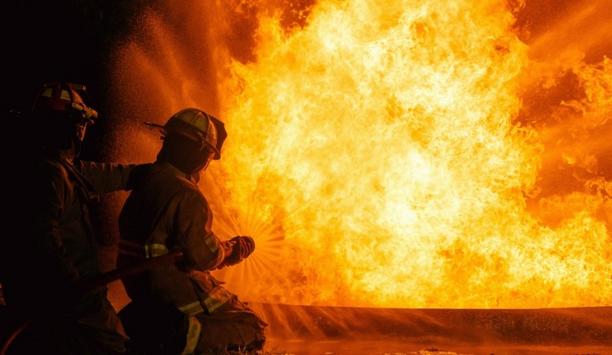
The New Future For Fire Agencies
Download
The Eight Key Trends in Fire Detection in 2023
Download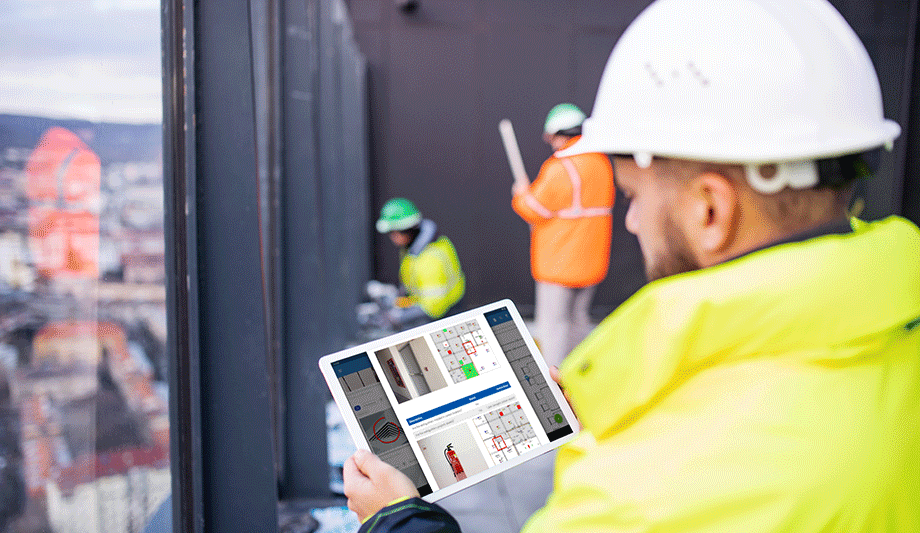
A Digital Platform to Improve Fire Safety Compliance and Inspections
Download
Overcoming the Challenges of Fire Safety in the Paper Industry
Download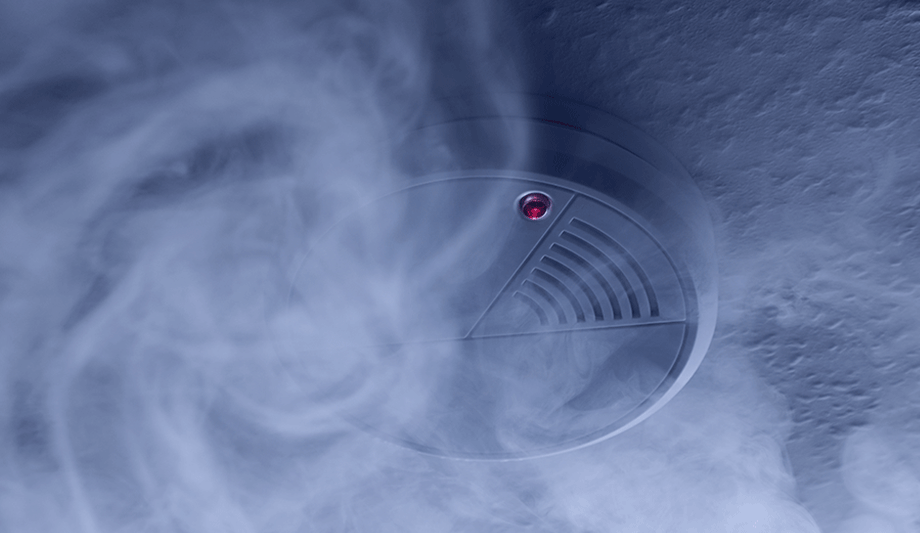
Carbon Monoxide: Creeping Killer Caught In The Act
Download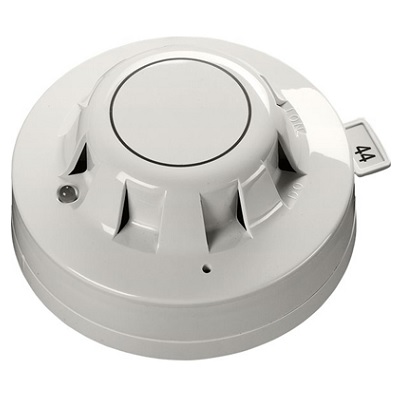
Apollo XP95 - 55000-600APO optical smoke detector

Apollo 2BP03 breakdown pole with 3 ft top section pike head
Apollo SOF-TOUCH SCBA mounting bracket with NFPA compliant straps