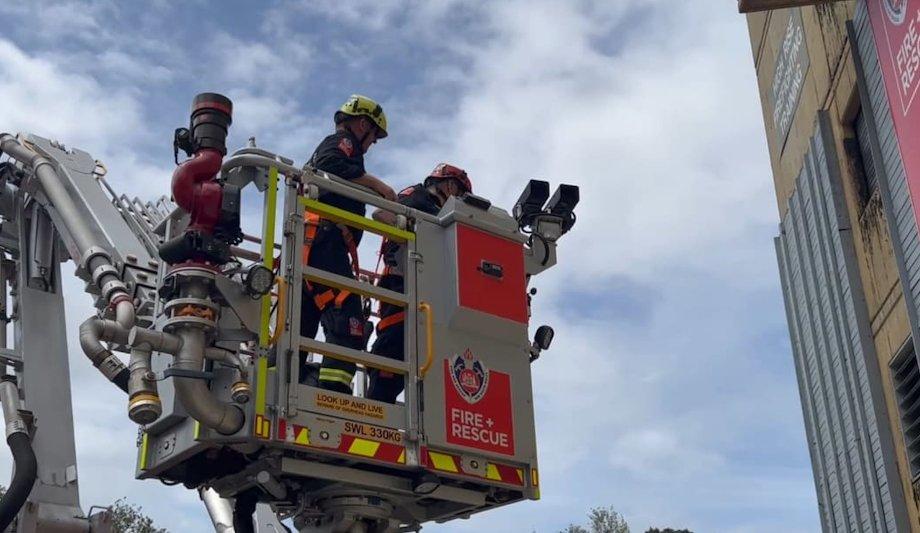
The Central Coast's fire safety capabilities have been enhanced with the introduction of a new $2.5 million Aerial Platform appliance by Fire and Rescue NSW (FRNSW).
This advanced piece of equipment, boasting state-of-the-art features, has now become an integral part of the firefighting arsenal for the region, stationed primarily at Bateau Bay.
Aerial Appliance Enhancements
The latest aerial unit incorporates Compressed Air Foam System (CAFS) technology, which combines water and foam to extinguish fires more quickly and environmentally efficiently than conventional methods.
Each vehicle includes tanks capable of holding 1650 liters of water and 250 liters of foam, with a pumping capacity of 6000 liters a minute, making it the most powerful pump in any Fire and Rescue NSW vehicle.
Support and Inspection
Emergency Services Minister Jihad Dib and Member for The Entrance David Mehan MP have reviewed the fire truck at its new Bateau Bay location. Minister Dib noted the importance of updating firefighting resources in line with community growth.
He emphasized that "the capability of our Fire and Rescue services needs to grow with our communities, and this new vehicle will significantly aid firefighters in their efforts."
Mr. Mehan echoed these sentiments, stating that this strategic addition will bolster efforts to reach higher residential buildings and enhance existing firefighting resources to protect lives.
Operational Versatility
The operational flexibility of this new platform was highlighted by FRNSW Central Coast Zone Commander, Superintendent Matt Waldon.
He pointed out, "We can deploy firefighters in the cage and extend them up to 24 meters in height to carry out high-rise rescues, or we can operate it via remote control from the ground, directing water from its hose onto a burning building."
The vehicle's lateral reach of 11 meters enables it to stretch over industrial complex roofs, and it can also lower three meters to access people or vehicles situated in embankments. Superintendent Waldon described the new platform as "a fantastic addition to our Central Coast fleet."
Fire and Rescue NSW (FRNSW) crews have taken possession of a new $2.5m Aerial Platform appliance that provides extra fire protection across the Central Coast. The coast’s firefighters have just finished training on the high-tech appliance, which will be predominantly based centrally at Bateau Bay.
The latest aerial appliance features Compressed Air Foam System (CAFS) technology that provides a mix of water and foam to put out fires, much faster and in a more environmentally-friendly fashion than water alone.
Aerial appliance
The vehicles have tanks, holding 1650 liters of water and 250 liters of foam in total
The vehicles have tanks, holding 1650 liters of water and 250 liters of foam in total, and have the capacity to pump at 6000 liters a minute, making it the most powerful pump on any Fire and Rescue appliance.
Emergency Services Minister, Jihad Dib, and Member for The Entrance, David Mehan MP inspected the fire truck at its new base. Minister Dib said the new resource recognizes the growth of the Central Coast area.
“The capability of our Fire and Rescue services needs to grow with our communities and this new vehicle will significantly aid firefighters in their efforts,” said Minister Dib, adding “The addition of this new, state-of-the-art aerial appliance, based out of Bateau Bay Fire Station, means it will be centrally located to respond to any elevated emergency anywhere on the coast.”
Firefighting resources
Mr Mehan said the new appliance was a welcome addition to the area to help protect communities.
“This new addition to the Central Coast is needed and will help assist in reaching higher residential buildings, as well as contributing to existing firefighting resources to help save lives,” said Mr. Mehan.
FRNSW Central Coast Zone Commander, Superintendent Matt Waldon, said the versatility of the new platform is very impressive.
Central Coast fleet
“We can deploy firefighters in the cage and extend them up to 24 meters in height to carry out high-rise rescues, or we can operate it via remote control from the ground, directing water from its hose onto a burning building,” said Superintendent Waldon.
He adds, “It has a lateral reach of 11 meters, so we can stretch it over an industrial complex roof, or we can lower it three meters to reach people or vehicles trapped down embankments. It makes a fantastic addition to our Central Coast fleet.”