ASSA ABLOY Opening Solutions - Experts & Thought Leaders





Latest ASSA ABLOY Opening Solutions news & announcements

For many different stakeholders in building design, construction, and management, security specifications can be a difficult, time-consuming task. Everyone from architects, developers, and contractors to security consultants, distributors, and even building inspectors benefits from trustworthy, transparent specification support for doors and related solutions. Digitalization and personalized service When the goals are better buildings, safer building users, and happier customers, the answer lies in a combination of digitalization and personalized service. A unified digital thread eliminates any confusion that can follow when stakeholders juggle multiple versions of documents. Personalized specification support ensures stakeholders select the right door solutions, project costs accurately, and minimize costly errors along the way. From design to handover, everyone works smarter. Software tools and specification support ASSA ABLOY specification experts can ensure fire safety and barrier-free accessibility are factored in From doors and door closers to wireless digital locking devices and complete digital access ecosystems, ASSA ABLOY has solutions for almost any building or opening. This vast range and breadth of project experience create uniquely broad-based knowledge, including about the latest innovations in low-impact mobile access and other energy-saving digital solutions. ASSA ABLOY specification experts can ensure fire safety and barrier-free accessibility are factored into early versions of a design, for example. This helps building owners and investors to meet compliance and safety requirements directly from project initiation, saving time and stress. Openings Studio™ ASSA ABLOY software tools such as Openings Studio™ help security security specialists and distributors specify accurately and manage stock efficiently. When a digital thread is maintained through building management, fire and safety inspectors complete their tasks time- and cost-efficiently. Openings Studio brings projects together in one intuitive environment by creating a transparent digital platform where everyone contributes. For this reason, it is already deployed all over the world as a trusted design, specification, compliance, and ordering tool – for building projects of every size and type. Benefits Deployed alongside personalized support from locally based ASSA ABLOY specification teams, it offers material benefits to every stakeholder. Stakeholder #1: Architects Openings Studio streamlines this without eating into the time architects need to focus on design To realize their vision for the final building, architects need everyone on the same page. Efficient collaboration and effective management of communication help them stay in control of project quality and timelines. Openings Studio streamlines this without eating into the time architects need to focus on design. Saves time “Openings Studio software introduced us to a whole new way of thinking and efficiency,” says David Zarhy, whose firm Zarhy Architects used Openings Studio for the Broadcom R&D Center at Tel Aviv University. The project transparency and knowledge-sharing that ASSA ABLOY brings to security specification is also invaluable, saving time and preventing mistakes. With detailed specifications supplied digitally at an early stage, architects visualize door and security solutions accurately as soon as possible. This way, aesthetics, and usability are not disrupted by last-minute hardware surprises. Stakeholder #2: Building Developers & Owners Investors want to maximize and future-proof the ROI from their property portfolio. At the same time, they have a responsibility to ensure compliance on measures including barrier-free building access and fire safety. Personalised specification support helps them to weigh options, meet their legal obligations, and control ongoing property management costs. To also meet the booming demand for green building accreditations, ASSA ABLOY offers in-depth support for developers seeking accreditation in six green building programs: BREEAM, LEED, Green Star, WELL, DGNB, and HQE. Sustainability credentials Another welcome benefit for ownership, returns on investing in greener buildings can boost more than just the environment. According to property experts JLL, “Buildings with better sustainability credentials are achieving markedly higher capital values and rents.” They estimated improvements of 20.6% and 11.6%, respectively, in one analysis of BREEAM-certified premises for the UK office sector. Stakeholder #3: Building Contractors Working smarter with software and specification support ensures customers come back In the construction phase, more than any other, time is money. Hitting every deadline and budget directly impacts the bottom line. Working smarter with software and specification support ensures customers come back in the future, supporting a sustainable, profitable business. The path from design to build is smoother when hardware data and deliveries are accurate, so all project changes must be communicated quickly along the stakeholder chain. Authoritative specification data Openings Studio ensures builders waste less time coordinating clients and suppliers – which means less disruption to their day-to-day work. Site workers access authoritative specification data for every opening quickly via intelligent tags and QR codes embedded within Openings Studio, for example, which saves time and prevents mistakes. Stakeholder #4: Security Hardware Specialists & Consultants The best way to keep customers coming back is by delivering great service. For hardware specialists, this means specifying technical jobs quickly and accurately. Tools and support that help automate tedious manual tasks and enable slicker collaboration to provide an awesome efficiency boost. ASSA ABLOY delivers support through a network of local BIM and specification teams, each with specific knowledge about applicable standards and regulations. Reusable and recyclable materials They supply products that are manufactured to eco-design principles and help reduce ongoing energy use. Detailed, product-specific EPDs highlight the concrete benefits delivered by ASSA ABLOY’s investments in using more reusable and recyclable materials, and in embedding low-energy and eco-design principles across its operations, detailed information that will be essential when the European Performance of Buildings Directive is implemented in 2026. Stakeholder #5: Distributors Effective coordination and accurate quotes are made easier and faster with the help of Openings Studio Satisfying customers means shipping the right products, on budget and time, every time. To achieve this, staying on top of current pricing and specifications is critical, even when these are in flux because a project is evolving. Effective coordination and accurate quotes are made easier and faster with the help of Openings Studio software. Intuitive tool Part of a longstanding collaboration with SWEDOOR in Denmark, a large project for Østre Landsret, the High Court for Denmark’s Eastern region, was streamlined with the help of Openings Studio. This intuitive tool underpinned door meetings, ensuring efficient decision-making and component delivery for every closer, lock, and cylinder. Safe and secure In Denmark and elsewhere, Openings Studio has become the focal point of collaboration between ASSA ABLOY, SWEDOOR, locksmiths, building contractors, and architects. According to Per Løvstad, Sales Manager at SWEDOOR JW Denmark, “Cooperation consists of a total review of the entire door project, door by door so that our mutual customer feels safe and secure that the doors and the entire package fit together. I can only recommend this collaboration to anyone who has to go through larger projects with doors and fittings.” Stakeholder #6: Building Inspectors Entrusted with making sure buildings are safe for users, inspectors need transparency in fire, safety, and accessibility compliance. In the past, this meant manual updates and endless spreadsheets – carried everywhere, even out of the office. “With Openings Studio, you no longer need to rely on paper or spreadsheets to manage doorset data,” explains Marc Ameryckx at ASSA ABLOY Opening Solutions EMEIA. “It’s all digitally managed in one place over the life of the building, which saves everyone’s time.” Openings Studio helps to maximize the effectiveness of inspections by safeguarding a reliable, up-to-date source of specification info and making it available on demand – even on an inspector’s mobile phone. Fire inspections The mobile app equips inspectors with powerful, speedy, and transparent reporting tools Doorview, who conduct fire inspections in the London area, uses Openings Studio to speed up their work. “The Openings Studio app allows us to instantly share fire door inspection reports with our clients,” explains Doorview’s Jody Purcell. The mobile app equips inspectors with powerful, speedy, and transparent reporting tools by leveraging the same information from the design phase through to the maintenance of the completed structure. Remedial action list The app also helps Doorview implement a remedial action list, which reassures the client that their building is compliant and safe. Maintenance staff can upload a photo when any required refits are complete. Working digitally with Openings Studio assures the transparency of this process. “Because specification and BIM teams are based at locations spanning ASSA ABLOY’s global network, they bring experience and expertise on local issues, standards, and certifications,” adds Marc. Digital collaboration “With digital collaboration in Openings Studio – plus dedicated specification support from a global team of local experts – ASSA ABLOY can help you transform the way you work." "You will deliver faster, better projects, hitting budget targets and meeting the needs of building managers and users, now and far into the future.”

The capability to maintain a smoke barrier prior to the need for fire containment is becoming an increasingly critical area for intumescent products. Lorient's LVN20S fire and cold smoke resistant air transfer grille, coupled with the Lorient Talkback Damper Control System, provides a comprehensive solution to this problem. In this article, they'll explain how the system works, along with the key features and benefits. The Lorient LVN20S for doors LVN20S is a unique product that contains fire and cold smoke within a room in emergency conditions The LVN20S is a unique product that contains fire and cold smoke within a room in emergency conditions, while still allowing for ventilation through doors in everyday use. It has the same intumescent, non-vision louvered slat configuration as the fire-only LVN20, but it also incorporates an electromechanically operated smoke shutter mechanism. This mechanism is controlled by Lorient’s Talkback Damper Control Unit (DCM), which receives a signal from the building’s fire alarm in the event of a fire. When the alarm goes off, the DCM triggers the shutters within the LVN20S to close, blocking the passage of highly toxic cold smoke. FD30S and FD60S fire doors Most large buildings require a significant number of FD30S and FD60S fire doors within any one fire zone. These doors may be a considerable distance apart, or even on different floors. The Talkback system has been designed to control up to sixteen air transfer grille assemblies from one centralised status monitoring unit. 2-way communication system The intumescent air transfer grilles in the LVN20S activate at temperatures above 100°C A unique 2-way communication system operates between the Damper Control and Monitor Unit (DCM) and the air transfer grille actuators. The intumescent air transfer grilles in the LVN20S activate at temperatures above 100°C. At this point, the material expands to form a solid block that stops the fire from spreading through the building for a designated period of time. Features + Benefits Can provide up to 60 minutes of fire and smoke resistance. Available to fit 44mm (FD30) or 54mm (FD60) doors. The Talkback can control up to 16 air transfer grille units. It fails-safe – the smoke shutters will automatically close in the event of an alarm, power failure or loss of communication. It resets automatically when the alarm is cancelled or power is restored. It is self-testing – every 24 hours, the dampers are automatically closed and opened to check they are working and to dislodge any dust and debris between the moving parts. It continuously monitors the status of each damper and displays this on the Talkback monitor (open, closed, or null). It is quick and easy to install – simple loop wiring is used, and the damper units are supplied ready assembled and tested. Uses a safe 12V DC supply to open and close the dampers. Tested in accordance with the requirements of the Electro Magnetic Compatibility and Low Voltage Directive and therefore bears the CE mark (copies of the relevant test reports are available on request). Non-vision - no cover grille needed. An additional audio monitor provides an alert in case any shutters fall into 'null' status. Additional battery backup is available in case of power failure.

To help support the Fire Door Safety Week 2021 campaign, ASSA ABLOY Opening Solutions UK & Ireland has announced the launch of a new best practice guide - ‘Fire Doorsets’ guide, on how to specify, install, maintain and inspect fire-certified doorsets in residential and commercial buildings. ‘Fire Doorsets’ guide The ‘Fire Doorsets’ best practice guide has been compiled, based on the knowledge and expertise of ASSA ABLOY’s FDIS-trained inspectors, as well as key insights, and information gathered from a range of third-party accreditation bodies, and trade associations, including the Door and Hardware Federation (DHF), the Fire Industry Association (FIA) and Secured By Design (SBD). The practice guide is intended to help all those responsible for fire safety in residential and commercial buildings The best practice guide is intended to help all those responsible for fire safety in residential and commercial buildings, such as architects and specifiers, installers, landlords, local authorities, building owners, and facilities managers, particularly at a time when fire safety is in the spotlight, due to the national Fire Door Safety Week 2021 campaign. Fire Door Safety Week 2021 campaign Scheduled to run from September 20 - 26, 2021, the Fire Door Safety Week 2021 campaign hopes to raise awareness of the critical role that fire doors play in saving lives and protecting property. Established by the British Woodworking Federation (BWF) and supported by the BWF Fire Door Alliance, the awareness campaign illustrates why it’s crucial to understand the factors that ensure a fire door performs as intended, with product manufacture, quality, installation and maintenance, all playing a part. Eryl Jones, Managing Director of the ASSA ABLOY Door Hardware Group, said “The correct specification, maintenance, and management of fire doors can be the difference between life and death for people, not to mention the damage fires can cause to property and valuables. In our new ‘Fire Doorsets’ guide, we tackle all considerations, throughout a fire doorset’s lifecycle.” Empowering fire safety personnel He adds, “From standards, certification, and security, to their design, specification, and installation, right through to their ongoing usage, maintenance, and inspection, our intention is to help empower those responsible for fire safety, with everything that they need to know.” Some of the statistics surrounding fire safety in the United Kingdom (UK) are staggering" Eryl Jones further said, “Some of the stats surrounding fire safety in the UK are staggering. There are 20,000 commercial fires in the United Kingdom every year. Research suggests that the economy has lost £1 billion in GDP and 5,000 jobs from preventable fires in commercial properties. One study found that larger fires in schools cost on average £2.8 million to repair and in some cases, as much as £20 million.” Fire doorsets play critical role in protecting life, property He adds, “Last year, a Freedom of Information request responded to by 147 UK local authorities, found 63 percent of planned fire door maintenance and the replacement did not progress, as scheduled. It’s clear that there’s still plenty of work to be done around improving awareness of the critical role that fire doorsets play in protecting life and property.” Eryl Jones concludes by stating, “We hope our new guide acts as an invaluable resource for those tasked with fire safety in buildings, ensuring everyone throughout the doorset’s lifecycle plays their part, in upholding the highest fire safety standards.”
Insights & Opinions from thought leaders at ASSA ABLOY Opening Solutions

A fire door is designed to stop fire and smoke from spreading, giving people time to escape and protecting property. It looks similar to a regular door but is built and tested as part of a complete system that includes the door leaf, frame, seals, and hardware. People often think any heavy or solid door will work as a fire door, but that is not the case. Fire doors are tested as complete systems, and every part – from the frame and hardware to the seals and glazing – must meet the tested specification. If you change a component or cut into the door without the correct approval, it may not perform properly in a fire. Fire gates or fire curtains “Fire doors are not just building components; they are part of the building’s fire strategy,” says Daniel Swannack, Chief Commercial Officer, Door Product Segment at ASSA ABLOY Opening Solutions EMEIA, adding “Their job is to hold back fire and smoke long enough for people to get out safely.” Fire doors are rated to hold back fire for a set time, such as 30, 60, or 90 minutes. In some cases, where a standard door is not practical, you might see sliding fire gates or fire curtains used to protect larger openings. Sliding doors are commonly used in car parks and industrial spaces where wide access is needed. Sliding doors are commonly used in car parks and industrial spaces. Fire curtains or sliding systems Many fire doors operate manually, but there are also hinged fire doors that can be automated Fire doors work by containing fire and smoke to one area, keeping escape routes clear for as long as possible. They do not need power or intervention – they simply have to be closed and in good condition. Features such as intumescent seals, which expand with heat, and fire-rated cores help to keep fire under control. Many fire doors operate manually, but there are also hinged fire doors that can be automated. In larger or open spaces, fire curtains or sliding systems provide the same protection by closing automatically. EI classification for integrity and insulation The type of building and how it is used make a big difference in choosing the right fire door. In hotels or offices, timber doors are often chosen for their appearance and acoustic qualities. In industrial sites, data centers or high-security areas, steel doors might be the better option. Wide openings in places like warehouses, airports, or underground car parks may need sliding fire gates or curtains instead. Local regulations also play a role: in much of Europe, fire curtains need to meet EI classification for integrity and insulation, while in the UK EW classification is often accepted, which focuses on integrity with limited heat radiation. EI-rated curtains Fire curtains are tested to EN 1634-1, and where smoke control is needed, to EN 12101-1 or EN 1634-3 Across Europe, fire doors are covered by EN 16034, with testing done under EN 1634-1 for fire resistance and EN 1634-3 for smoke control. Hardware is tested separately under EN 1634-2. In the UK, BS 476 is still recognized alongside EN standards. Fire curtains are tested to EN 1634-1, and where smoke control is needed, to EN 12101-1 or EN 1634-3. EI-rated curtains block both fire and heat transfer, while EW-rated systems, often used in the UK, focus on integrity with reduced heat radiation. Testing is always conducted on the complete system, including the door, frame, and hardware, to make sure everything performs as intended. Third-party certification “To maintain this performance, installation must follow the certified details exactly,” says Daniel Swannack, adding “If the door is not installed properly, it may not meet its fire rating even if all components are correct.” Third-party certification proves that the product has been tested, audited, and produced consistently to meet safety standards. Certification is a vital reassurance for building owners, architects, and insurers that the door will do its job in any emergency. This applies to all fire doors, whether timber or steel, and to larger solutions like fire gates and curtains. Certification also helps to smooth the approval process with building control and demonstrates compliance with legal requirements. Fire door’s effectiveness Fire doors and curtains can be linked to alarms so they automatically close when needed Smart building systems can contribute to a fire door’s effectiveness by keeping track of fire doors, showing if they are closed, blocked, or need maintenance. Fire doors and curtains can be linked to alarms so they automatically close when needed, or connected with access control to ensure compartmentation is maintained. In complex environments, such as hospitals or data centers, these systems also provide useful reporting and maintenance records, ensuring doors are always ready to perform. Automatic systems “Fire doors must be kept in good working order to be effective,” says Daniel Swannack, adding “This means checking the seals, hinges, closers and making sure they shut fully and are undamaged.” Automatic systems like fire curtains, sliding doors, and automated hinged doors need their motors and controls tested, too. Many regulations call for checks every six months in busy areas. A fire door is only as good as its maintenance, and a small fault may make a big difference in an emergency. Sustainability goals by using the Forest Stewardship Council Timber fire doors can have custom finishes, painted surfaces, or hidden hardware To maintain protection while achieving aesthetics, there is a lot of flexibility now when it comes to design. Timber fire doors can have custom finishes, painted surfaces, or hidden hardware, while steel doors may be color-matched or clad to fit the interior or exterior architecture. In hotels, residential buildings, and offices, getting the right look is often just as important as performance. “We work with architects to make sure our doors meet fire standards without compromising the overall design,” says Daniel Swannack. Fire doors can support sustainability goals Fire doors can support sustainability goals by using Forest Stewardship Council (FSC)-certified timber, low-volatile organic compound (VOC) coatings, and recyclable steel. “Many of our doors also come with Environmental Product Declarations, which provide verified data on their environmental impact,” adds Daniel Swannack. Reduce waste and replacement cycles Durability is another factor: Long-lasting products reduce waste and replacement cycles. “The challenge is to combine all that with reliable fire performance, and this is where proper testing and certification really matter,” Daniel Swannack says. Choosing the right door Whether in a school, hospital, apartment block or industrial site, choosing the right door and keeping it properly maintained is essential. “Our role is to make that process easier by combining compliance, performance and, where needed, design flexibility,” concludes Daniel Swannack.
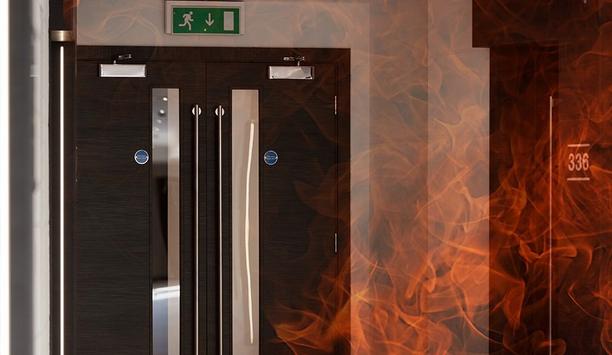
Last year saw a 14 per cent increase in fires in England, according to UK Home Office statistics. And while around three million fire doors are installed in the UK every year, a lack of understanding during operation, maintenance and management of fire doors is still apparent. In this article, David Hindle, Head of Door Closer Sales at ASSA ABLOY Opening Solutions UK & Ireland, will address this issue. Importance of fire doors Fire doors are often the first line of defense in a fire, yet even after the Grenfell Tower tragedy in 2017, fire door hardware remains a significant area of concern. In May 2018, an Independent Review of Building Regulations and Fire Safety, led by dame Judith Hackitt, have been published. The review highlighted a range of issues, but the message stood clear, the UK’s current approach to fire safety in buildings is not functioning as intended and a new, holistic approach to fire safety is required. Review of fire inspections In all fire inspections, there is a responsibility from the building owner to include checks on the fire doors In all fire inspections, there is a responsibility from the building owner to include checks on the fire doors. However, there is no legal requirement for them to complete any recommended upgrades or repairs, or to prove that they have done so. This represents a major problem, as doors that do not perform to the required standard could compromise a building’s safety and put occupants at risk. Ultimately, this could lead to liability being assigned back to the building owner or facilities manager. Need to maintain fire safety standards Fire safety is only properly maintained if standards and checks are carried out throughout the lifecycle of the product and building. This is best addressed through regular inspection, maintenance and the replacement of products when required. A review by the Fire Door Inspection Scheme revealed the most common fire door faults, ranging from missing fire or smoke seals, to unsuitable hinges and damage to the door leaf itself. Any one of these issues can render a fire door useless and can seriously impede a door’s capability to protect people from harm. Door leaf and frame maintenance Fire door hardware is often not afforded the attention it requires and is left mismanaged throughout its service life. So what needs to be done to ensure fire door hardware is working as expected? Naturally, the door leaf should not be damaged, warped or twisted, and it is vital to ensure the fire door closes correctly around all parts of the frame, with no distortion between the stiles, top and frame. Gaps between the door and leaf must not be greater than those specified in the manufacturer’s installation instructions or fire certificate data sheet, typically around 3 to 4mm all the way round. Importance of door closers A door closer ensures a fire door returns to its fully closed position and the door seals correctly in the door frame A door closer ensures a fire door always returns to its fully closed position and makes sure that the door seals correctly in the door frame, when not in use. There are three steps to ensuring these components are working correctly. First, open the door fully and check that it closes without dragging across the floor. Next, open it to approximately 5-10 degrees and again check that it fully closes, engaging any latch or seal. Finally, check the door closing speed is approximately five seconds from a 90 degree angle, ensuring the door does not slam shut. Intumescent fire and smoke seals Fire and smoke seals should be in good condition, fit the full length of the door and be secure in the groove. If seals are badly fitted, damaged or painted, then they must be replaced with exactly the same size and intumescent material that was originally specified. If the smoke seals have to be replaced, then they should be fitted in one continuous length, if possible. To ensure hinges are in good condition, check for visible wear, dark marks or stains around the hinge knuckle that could indicate wear and impending failure. Hinges must be strong enough to carry the door mass, plus robust enough to work efficiently no matter the level of usage. The hinges should be firmly screwed into the door and frame, ensuring that the seals at the top and sides of the door are not damaged or missing at any time. Intumescent pads should also be used with hinges, as these are required for the door to get its appropriate fire rating. Locks and lever handles To measure a handle’s condition, one needs to ensure the lock lever fully returns to a horizontal position after use Wiping any metal dust deposits off the handles will help ensure that the latch-bolt is engaging smoothly and completely into the keep during use. To measure a handle’s condition, one needs to ensure the lock lever fully returns to a horizontal position after use. If it does not, the lever may, at best, need adjusting or lubricating. At worst, it may need replacing, as per the manufacturer’s instructions. Again, ensure the lock case is protected by intumescent material. Maintaining record of fire door inspection No matter the component, a record of inspection and maintenance should be kept for all door hardware. Furthermore, those responsible for ensuring the fire safety of a site should encourage others to report any issues with any of the door components. Faults should be fixed as soon as possible, using the correct and fire-rated components. To check the compatibility of components, always consult the fire certificate data sheet or contact the manufacturer.
The New Future For Fire Agencies
Download
The Eight Key Trends in Fire Detection in 2023
Download
A Digital Platform to Improve Fire Safety Compliance and Inspections
Download
Overcoming the Challenges of Fire Safety in the Paper Industry
Download
Carbon Monoxide: Creeping Killer Caught In The Act
Download