|
| Fire researchers conducting field experiments into the effects of wind-driven fires |
The two technical reports from this project, 'Fire Fighting Tactics Under Wind Driven Conditions: Laboratory Experiments' and 'Fire Fighting Tactics Under Wind Driven Fire Conditions: 7-Story Building Experiments', as well as an accompanying instructional DVD set, document and discuss firefighting tactics demonstrated to reduce the thermal hazard created by a wind driven fire.
"The dynamics created for firefighters faced with an uncontrolled fire in a building are challenging and complex. Firefighters have long been aware that the presence of an external wind has the potential to increase the energy release of any given fire and increase the spread of fire gases through a structure," said Glenn A. Gaines, Acting Assistant Administrator for the USFA. "The important information gained from the project's experiments will help the fire service better understand and manage hazards associated with wind driven fires."
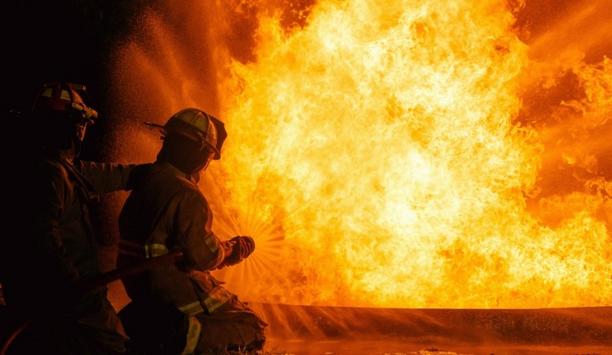
Eight laboratory experiments conducted as part of this project demonstrated the extreme thermal conditions that can be generated by a "simple room and contents" fire and how these conditions can be extended along a flow path within a structure when a wind condition and an open vent are present. In addition, use of two potential tactics, a wind-control device (WCD) from the floor above the fire and external water application from the floor below the fire, were shown to reduce these wind driven thermal hazard conditions.
Results from an additional series of 14 experiments conducted in a 7-story apartment building confirmed that conditions created by wind rapidly caused the building's environment to deteriorate by forcing fire gases through the apartment of origin and into the public corridor and stairwell.
Several tactics, including positive pressure ventilation fans, WCDs, and external water application with floor below nozzles, were again shown to have a significant impact on reducing the hazardous condition created by a wind driven fire. In addition, use of multiple tactics in conjunction with each other was also shown to be very effective at improving conditions for firefighter operations and occupant egress.
The research data provide the science to advocate for improved standard operating guidelines for the fire service to enhance firefighter safety, fireground operations, and use of equipment. To review the two technical reports and learn how to get a copy of the instructional DVD set, please visit the following USFA web page: http://www.usfa.dhs.gov/fireservice/research/dsn/dsn_wind_conditions.shtm