Schneider Electric - Experts & Thought Leaders


Latest Schneider Electric news & announcements

PACCAR is excited to collaborate with Faith Technologies and Schneider Electric to provide charging infrastructure solutions for customers who purchase battery-electric Kenworth and Peterbilt trucks in the United States and Canada. Kenworth and Peterbilt have recently begun taking customer orders for production model Kenworth K270E and the Peterbilt Model 220EV battery-electric trucks, with additional production models to be introduced in the coming months. PACCAR’s extensive zero-emissions field testing program, with customers operating more than 60 Kenworth, Peterbilt and DAF test trucks, will provide valuable real-world experience to enhance these future product launches. Comprehensive charging solution “We are pleased to partner with Schneider Electric and Faith Technologies to bring this outstanding solution to our customers and dealers,” said Kyle Quinn, PACCAR chief technology officer. “Customers will receive the industry-leading operating efficiency and environmental benefits of Peterbilt and Kenworth zero-emissions truck models, combined with a comprehensive charging solution utilizing Schneider Electric and Faith Technologies’ products and services.” Kenworth and Peterbilt customers will be able to order electric chargers from PACCAR Parts. PACCAR Financial will provide flexible financing options for infrastructure and charging systems. PacLease will bundle the cost of charging systems within full-service lease offerings to customers. The partnership will help customers navigate the numerous financial incentives available from a variety of government agencies in the U.S. and Canada. Electric truck deployment Faith Technologies welcomes this opportunity to collaborate with PACCAR" “As the world’s leader in energy management, we are proud to partner with Kenworth and Peterbilt in enabling their electric truck deployment and offer our infrastructure leadership and reliable approach to microgrids,” said Annette Clayton, Schneider Electric North America chief executive officer & president. Schneider Electric provides electrical infrastructure, energy-as-a-service, and services & software solutions for efficiency and sustainability under the Square D, APC, and Aveva brands, among others. “Faith Technologies welcomes this opportunity to collaborate with PACCAR. We especially look forward to working with Kenworth and Peterbilt and their customers to prepare the charging infrastructure for battery electric trucks,” said Mike Jansen, Faith Technologies chief executive officer and chairman of the board. Manufacturing advanced powertrains Faith Technologies brings nearly 50 years of experience to perform the electrical and engineering design work and maintain the equipment after the sale. PACCAR is a pioneer in the design, manufacture, and customer support of high-quality light-, medium- and heavy-duty trucks under the Kenworth, Peterbilt, and DAF nameplates. PACCAR also designs and manufactures advanced powertrains, provides financial services and information technology, and distributes truck parts related to its principal business.

The two-day Airport Solutions Mexico exhibition and conference will be held 3-4 May 2017 at the Centro Citibanamex The inaugural Airport Solutions Mexico 2017, part of the Airport Solutions Global Series of events, is being officially sponsored by Schneider Electric, a software solutions provider. Bringing together industry’s buying chain The two-day Airport Solutions Mexico exhibition and conference will be held 3-4 May 2017 at the Centro Citibanamex, Mexico City and is expected to attract more than 2,000 B2B buyers and 200 delegates. It is unique in that it will bring together the industry’s entire buying chain, providing a platform to connect suppliers with stakeholders and decision makers whilst assessing key issues and solutions in the international conference programme. Diego Bianchini, Schneider Electric’s Senior Channel Manager for Mexico & Central America Software stated, “Our software solutions help customers to increase efficiency and profitability, improve information and decision-making and meet statutory and validation requirements. The solution enables them to manage a large number of processes in an integrated and simultaneous manner under a single platform - even with so many devices and signals with distinct technological languages. Mexico´s airport project can become a successful AeroMetropolis as it has the scale and volume, if planning and efficiency can be achieved and we can help to achieve it.” Schneider Electric will be presenting in the high level two day conference, on a success story in a similar Airport using their software: “The centralisation offered by Wonderware technology is essential. It allows us to respond to incidents rapidly and be proactive in making process improvements, because now we have real-time unified information available to us for analysis.”
Intersec Saudi Arabia 2017 is expectedto host more than 100 exhibitors, including 22 launch partners Saudi Arabia and the UAE are leading the upward trend for the fire safety systems market in the Gulf Cooperation Council (GCC), as stringent government regulations fuel demand for the replacement of existing and outdated equipment. According to consultancy firm 6Wresearch, the GCC’s fire safety systems market was worth US $ 1.36 billion in 2015, with Saudi Arabia (US $ 598.4 million), and the UAE (US $ 394.4 million) comprising 73 per cent of the regional market. The other Gulf States of Bahrain, Qatar, Oman, and Kuwait accounted for US $ 367.2 million (27 per cent). Fire safety system market growth 6Wresearch said Saudi’s fire safety systems and equipment market is projected to grow six per cent annually from 2016 – 2020. By 2022, the market is estimated to be worth US $ 632.2 million, attributed to a recovery in the construction and real estate verticals. Other factors driving regional demand for new fire safety systems include government and transportation sectors, residential, retail, and hospitality verticals, while Saudi’s Vision 2030 and the upcoming Dubai Expo 2020 in the UAE is also likely to boost further growth. The latest market updates were told to more than 100 fire, safety and security industry professionals at a three-day Saudi roadshow promoting the upcoming Intersec exhibitions in Dubai and Jeddah. Intersec Dubai 2017 Intersec, the world’s leading exhibition for security, safety, and fire protection, runs from 22-24 January 2017 at the Dubai International Convention and Exhibition Centre, while Intersec Saudi Arabia will take place from 2-4 May 2017 at the Jeddah Centre for Forums & Events. In its 19th edition, Intersec 2017 will feature more than 1,300 exhibitors from 54 countries spanning over 55,000sqm of exhibition space, registering a 10 per cent growth over the previous year. Intersec Saudi Arabia 2017 The first edition of Intersec Saudi Arabia meanwhile is expected to host more than 100 exhibitors, including 22 launch partners; Al Alameya Group, Axis Communications, Bristol Fire Engineering – Corodex, the British Security Industry Association, CP Plus, Dahua, dorma + kaba, Draeger, Genetec, Hanwha Techwin, Harco Group, HID Global, Hikvision, Milestone, NAFFCO, Nedap, Pelco by Schneider Electric, Promise Technology, Smiths Detection, Tadween, NITIE, and ZMR. Fire & rescue section Fire & Rescue is one of seven show sections at Intersec 2017, and has nearly doubled in size over the last four years. The section, which attracted 350 exhibitors in 2016, is expected to continue its growth trend in 2017, having attracted the likes of Apollo, bsi, Bristol, Chemours, Fike, Hochiki, Grupo Komtes, LPCB, NAFFCO, Oshkosh, Rapidrop, Scott Safety, Securiton, SFFECO, Siemens, UL, and Velox. “Ongoing investments in the commercial, retail, industrial, hospitality, and the healthcare sectors, combined with upcoming high profile international events, means growth is the buzz word across all sectors in the GCC, and this also applies to the fire safety market,” said Ahmed Pauwels, CEO of Messe Frankfurt Middle East, the organiser of Intersec, and Intersec Saudi Arabia. “Improvements in the enforcement of fire codes in the construction sector, and the constant need for fire protection and life safety means the GCC’s fire safety market is estimated to grow annually by 14-16 per cent to reach US$3.15 billion by 2020.” “This robust demand for the latest equipment, fire protection and firefighting systems is reflected in the strong growth in the Fire & Rescue section at Intersec, while Intersec Saudi Arabia too will host the biggest names in the fire protection market,” added Pauwels. Oil & Gas Oil & Gas is another key sector for the fire protection industry, and will be a key target area for Hochiki at Intersec 2017. The Japanese-headquartered company specialises in commercial and industrial fire detection and emergency lighting solutions, and will showcase its latest range of fire detection products designed specifically for use in oil refineries, gas processing plants and other high risk environments. “Expenditures in the Middle East oil and gas sector are expected to increase by more than 19 per cent for the 5-year period ending in 2017,” said Robert Head, Assistant Managing Director at Hochiki Middle East. “When operating in such hazardous environments, it’s important to ensure the building’s fire safety systems are robust and reliable. There’re a variety of fire detection products designed specifically for use in oil refineries, gas processing plants and other high risk environments.” “Intrinsically Safe devices (IS) restrict the electrical and thermal energy in the circuit ensuring that ignition in an explosive atmosphere cannot occur; making them ideal for use in oil and gas facilities as well as chemical engineering plants. Hochiki have a wide range of IS devices, from smoke detectors to flame detectors, which have all been certified by BASEEFA to IECEx and ATEX,” added Head. New panel and product launches Global Fire Equipment from Portugal, a manufacturer of fire detection and extinguishing systems will return to Intersec 2017 with the launch of its new panels and several other products like PA/VA systems, and web enabled interfaces. João Paulo Ajami, the Commercial Director for Global Fire Equipment, said, “We had several interesting projects in Saudi Arabia in the last 12 months, while exhibiting at Intersec has helped us launch several good distribution channels in countries like Kenya, Saudi Arabia, the UAE, Tanzania, and Pakistan.” “Our goal is to establish long term partnerships with agents working in the security field with the purpose of expanding our global presence which covers more than 70 countries. Our systems are applied in residential, commercial and industrial sectors and its subsectors, since fire detection is applicable to almost all construction sectors.” Regional fire safety codes Elsewhere, Aman Fire Protection, an Oman-based fire protection engineering consultancy, will look to increase its business contacts at Intersec 2017 and explain the fire codes approvals process to those undertaking projects in the Middle East. Anthony Cole, Technical Director at Aman Fire Protection, highlighted the growing trend for better awareness of regional fire safety codes following recent fire incidents across the GCC. “There’s an increase in awareness for the need for review and approval of materials used in construction by fire protection consultants especially in high rise projects following the several high profile fires,” said Cole. “Oil & Gas, military, power and energy creation, large commercial developments such as shopping malls and integrated tourism leisure projects are the most important industries our business is targeting now.” Intersec’s other core sections include Commercial Security, Homeland Security & Policing, Safety & Health, Information Security, Smart Home and Physical & Perimeter Security.
Insights & Opinions from thought leaders at Schneider Electric

There are many daily risks faced by buildings and their managers, with electrical fires being one of the most common and dangerous. Commercial fires impact occupant health, property and the business itself – with 25% of businesses who suffer a fire never reopening. Given the often-unpredictable nature of electrical fires, businesses must invest in the latest technologies to prevent irreparable damage. It is the responsibility of the consultant engineer to show leadership and initiative in improving safety to protect the business, its employees and its most valuable assets. Engineers must look beyond simply tackling overloads and short circuits and examine a range of connected solutions that can stop a fire before it even has a chance to begin. This drastically reduces the cost of damages and repairs, while giving building operators unrivalled visibility. Connected protection is crucial at every level of the circuit, from the switchboard to distribution. A centralized system for equipment monitoring and detection provides building managers with all the information they need to keep fire risk under control, and therefore protect staff, property and business. Electrical fire risk awareness During the design and implementation phase, the consultant engineer’s role is traditionally to respect and master the local standards. They should ensure all components and parts of the circuit comply with the latest wiring rules, electrical and building codes. Yet for enhanced safety they should also be willing to look beyond the standards of the day. Given the often-unpredictable nature of electrical fires, businesses must invest in the latest technologies to prevent irreparable damage Today’s regulations do a good job of protecting buildings from the dangers of short circuits and overloads, mostly by mandating the use of circuit breakers. However, consultant engineers should also be aware of the risks posed by circuit deterioration and mistakes made during the installation. Loose cabling and faulty insulation or connections – even something as small as an untightened screw – can significantly increase a circuit’s fire risk. It’s up to consultant engineers to know their market and provide solutions that go beyond the minimum to detect and prevent electrical fires. Why electrical engineers must go the extra mile A stitch in time saves nine. While tackling overloads and short circuits is crucial, engineers must go further, examining a range of connected solutions that can stop a fire before it even has a chance to begin. Acting pre-emptively can drastically reduce the cost of damages and repairs and provide building operators with unrivalled visibility of their facility. Connected protection is crucial at every level of the circuit, from the switchboard to distribution. A centralized system for equipment monitoring and detection will provide the building manager with all the information they need to keep fire risk under control. Connected protection is crucial at every level of the circuit For optimal protection, organisations should employ smart, connected solutions that detect fire and the risk of fire at every level. This means additional protection for the switchboard and the circuit at all levels of the electrical installation, underpinned by a centralised system for monitoring and pro-active action. Using Residual Current Devices (RCDs) against insulation faults triggered by earth leakage currents exceeding 300mA, is a familiar solution. Engineers now have access to more effective earth leakage protection solutions with the same footprint as a classical overload and short-circuit protection. Products can now also offer permanent earth leakage current measurement which, when connected to a monitoring system, allows pre-alarming and monitoring during the time of any drift in the insulation. Identify switchboard vulnerabilities Unprotected electrical switchboards are especially vulnerable to fire risk. The equipment is susceptible to rodent infestation and internal overheating, issues that can often go unnoticed until it is too late. The IEC 61439-2 Low-voltage switchgear and control gear assemblies – Part 2: Power switchgear and control gear assembly’s standard addresses these risks, making compliance a must. However, fulfilling these design and manufacturing rules for switchboards does not eliminate the risk of connection failure. A critical sequence of events can occur. First, increasing electrical contact resistance accelerates further deterioration. This increased resistance induces a rise in temperature – high temperatures deteriorate the connection surface even more. The more deteriorated surface leads to a further increase in contact resistance, and the resulting thermal runaway will cause complete connection failure. Fire, flash-over and explosions become a real risk. Enhanced electrical fire prevention Moreover, final circuits should be protected by an arc fault detection device (AFDD) for enhanced fire prevention. Final circuits should be protected by an arc fault detection device (AFDD) Circuits age unevenly and unpredictably, so persistent monitoring and predictive maintenance are key to limiting fire risk. Cloud analytics can help provide asset health analytics to interpret the status and history of your most critical assets, with preventive notifications and 24/7 support. Fire prevention must be a top priority when assessing all the safety and risk-management of a building. In the case of electrical fires, prevention is better than cure. Therefore, establishing the right approach before crisis strikes will be invaluable. Connected solutions across the entire circuit are an effective solution for consultant engineers to defend buildings from the often-underestimated dangers of faulty installation and ageing components. In short, smart electrical fire prevention provides peace of mind for engineers, facility owners and occupants alike.

New government legislation due to come into force in the United Kingdom on July 1st will require electrical installations in privately rented properties to be tested and inspected at least once every 5 years. The Electrical Safety Standards in the Private Rented Sector Regulations (2020) will require landlords to enlist qualified electricians to complete inspections and provide certification to tenants – or face fines of up to £30,000. While the risk of fire can never be entirely eliminated, the new legislation will introduce higher levels of safety and ensure that one of the primary causes of fire – electrical malfunctions – is regularly tested for. There are a number of procedures and regulations in place for when a fire has already started, but this new law will help to reduce the chances of it getting to that point. After all, prevention is the best form of protection. No safety procedure or response plan will ever fully prepare someone for the reality of a fire. However, a comprehensive prevention strategy and use of the latest technologies to quickly detect and respond to a fire can at least reduce the potential risk to both life and property. Defensive detection A fire can spring from many sources. Current standards do a good job of ensuring properties are well equipped to defend against fires created by overcurrent caused by overloads and short circuits. A comprehensive prevention strategy and use of the latest technologies to quickly detect and respond to a fire can at least reduce potential risk However, electrical fires can also result from mistakes made during the installation process, namely loose cabling or aging circuits that will not be detected by overcurrent protection. Indeed, a defective or worn insulation is the cause of 14% of all electrical fires in buildings. The danger of landlords only performing the bare minimum to protect their buildings is that, should a fire start from a source they haven’t accounted for, the loss and disruption to property could be devastating. For maximum protection, individuals need reliable, innovative products that excel beyond the minimum standards to prevent a fire from starting in the first place. The pending legislation will add to this safety from the start. It will require landlords to use qualified electricians when installing, repairing and maintaining systems, benefitting both landlords and tenants by mitigating electrical issues and instilling greater confidence. Protection against insulation faults The risk of cable insulation faults grows over time and the consequences can be severe. Low-intensity arc faults are more likely to occur in humid, dusty environments, causing injury and deadly fires if precautions aren’t taken. Protection against insulation faults within cables can be assured by residual current devices (RCD), which are triggered by earth leakage currents exceeding 300mA. For maximum protection, individuals need reliable, innovative products that excel beyond the minimum standards to prevent a fire from starting Additionally, final circuits in critical locations (as recommended in IEC 60364), should be protected by an arc fault detection device (AFDD). This is a circuit breaker that automatically cuts off the electricity supply when it detects an arc fault in the circuit. By immediately stopping the supply, AFDDs stop arc faults from reaching temperatures where fires can break out. As well as ensuring that private tenants feel more safe and secure, the new legislation represents an opportunity for electricians to secure more work and develop their skills. Going forward, as the demand for electricians in the private rented sector rises, we expect to see greater opportunity for electrical engineers to win long running contracts with landlords and property managers. Fire may be a risk, but it is not unavoidable. This new legislation promises greater peace of mind for private tenants by ensuring that electrical standards are met and hazards reduced. With expert knowledge and the correct approach to electrical fire prevention, a fire can be extinguished before any damage is done.
The New Future For Fire Agencies
Download
The Eight Key Trends in Fire Detection in 2023
Download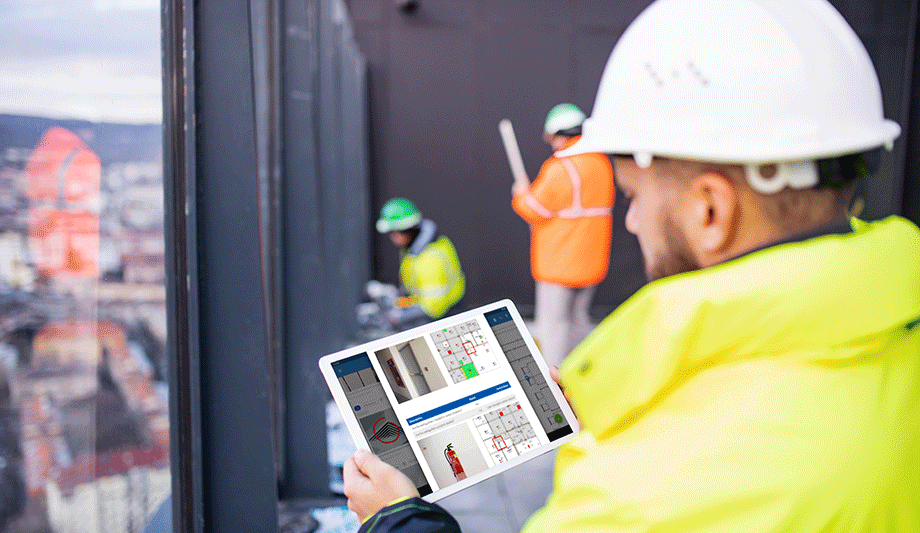
A Digital Platform to Improve Fire Safety Compliance and Inspections
Download
Overcoming the Challenges of Fire Safety in the Paper Industry
Download
Carbon Monoxide: Creeping Killer Caught In The Act
Download