
Science shows clearly that the way to reduce the damaging impacts of wildfires and threats to life and property is to proactively manage ecosystems that evolved with fire. This means reintroducing fire in the right ways and places combined with mimicking the effects of fire on forest structure through mechanical treatments.
“Rocky Mountain Research Station's Fire, Fuel, and Smoke Science Program (RMRS) focuses on the science of risk management from ways that they can treat fuels and mitigate risks to helping communities assess and mitigate risk and be more resilient,” says Thomas C. Dzomba, Deputy Program Manager and Director of the Fire Modeling Institute.
Missoula Fire Lab
During the current fire season, the Missoula fire sciences lab has made two major contributions:
Risk Management Assessment Team Support
The Risk Management Assessment Team has directly supported incidents across the west providing maps, real-time weather, terrain, control feature, and fire behavior data and information to help fire managers determine the best courses of action and probabilities of success for various suppression tactics and strategies.
Modeled Risk Of Spread Of COVID-19
Early in the season they modeled the risk of spread of COVID-19 in fire camp and evaluated key mitigation strategies. This information supported agency actions such as social distancing, module-as-one, masks, and testing, which have contributed greatly to the success in minimizing the spread of the disease under very difficult circumstances.
The 5-10 year Program Plan
Looking ahead to the next 5 to 10 years, the program plans to focus on:
- Profoundly improving the Forest Service’s ability to manage fire for the benefit of communities and natural resources by improving the understanding of fundamental processes of wildfire behavior and spread.
- Developing fuel-related tools, products, treatment alternatives, restoration strategies, and accurate forecasting of future conditions to help change the trajectory of increased wildfire and altered fire regimes.
- Improving the understanding of smoke impacts and how wildfire emissions respond to climate variability and changing landscapes, and developing mitigations.
- Building on and improving decision support systems, the effectiveness and efficiency of fire and forest management activities, and increasing the safety of planning and operations.
- Includes developing tools and models to help fire managers weigh trade-offs of decisions in real-time regarding suppression tactics, management strategies, and safety.
System Development
The Missoula fire sciences laboratory has a long history of producing and supporting systems for management use and will continue to engage in technology transfer in the form of system development.
“We live in ecosystems that are historically fire-dependent and have been altered over time by expansion of the wildland-urban interface, external factors such as climate change and the invasion of non-native species, and decades of active fire suppression,” says Dzomba.
“Our fire research must align with a more proactive approach to fire management that includes more managed fire on the landscape and a greater focus on restoring landscapes to historical fire regimes as opposed to the reactive approach of addressing wildland fire management after fire is already on the ground.”
Balanced Ecosystems
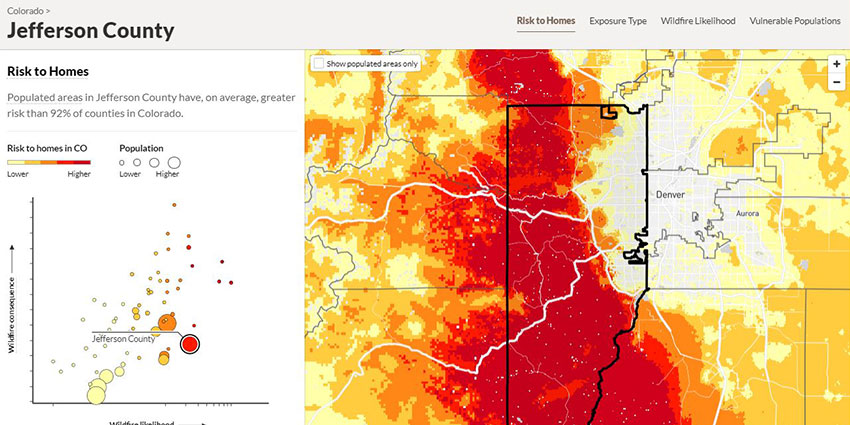 |
| Wildfire Risk To Communities website provides interactive information to help communities understand and mitigate wildfire risk. Greg Dillon, Rocky Mountain Research Station, Missoula Fire Sciences Laboratory |
Western landscapes evolved with fire; it is a necessary component to keep ecosystems functioning and in balance. Science and research clearly point towards solutions for reducing the risk of damaging wildfires, but knowing the answer doesn’t necessarily make it easy to get there.
That will take collaboration with local communities, state and federal partners, and science to help managers determine the best places and ways to more safely reintroduce fire to landscapes.
Building Resilience
There is no one-size-fits-all or magic bullet to make this happen. “Building resilience in our landscapes and communities will take all of us working together,” says Dzomba.
“Everyone has a part to play including preventing human-caused wildfires, reducing risks through vegetation management, managing fires in some landscapes when conditions are appropriate, and building in locations and ways that make communities and homes more resistant to fire.”